I was looking through that "Play Worlds, Not Rules" challenge on the d66 Classless Kobolds blog, and while I'm not planning to run my Eastern Territories setting in "free kriegsspiel" style, I thought making some play notes and tables might be helpful in kinda crystalizing my ideas.
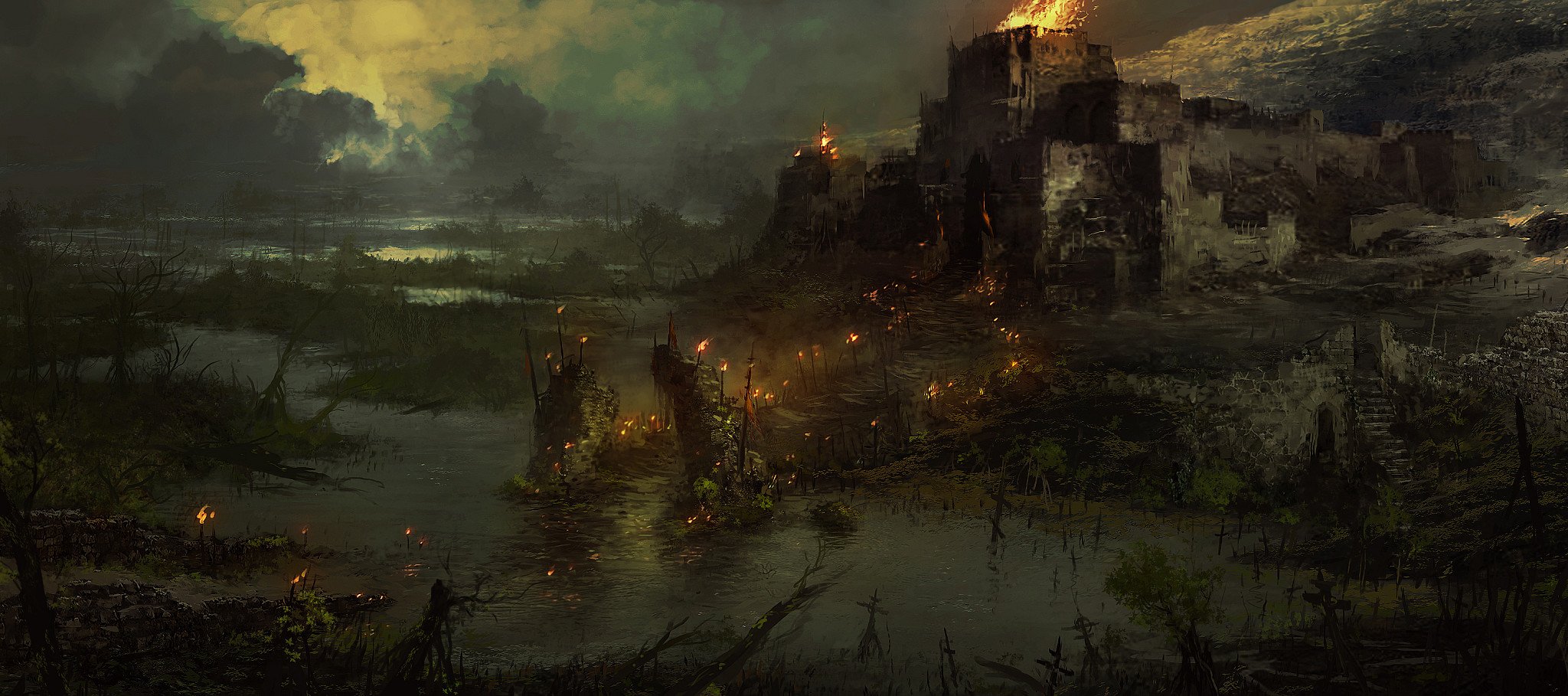
Diablo IV concept art
Context
This is a dark fantasy game in a setting with lots of magic, alchemy, spirits, undead, mutations, and weird posthuman, but without the usual hosts of demihumans, dragons, and other mythological and folkloric creatures. The aesthetics are influenced by things like Dark Souls, Mork Borg, and Berserk, and the tone is on the gritty side.
The Eastern Territories are a half-wild inland region of forests, plains, and hills that was partially conquered by the oppressive Empire of Flowers before it collapsed. The resulting power vacuum creates opportunities for bandits, warlords, new religions, new inventions, criminal organizations, and cunning adventurers. There are abandoned palaces to loot, little wars to fight, monsters to exterminate, and all sorts of tensions to exploit.
Tables
God, I love a good random roll table. Or a series of nested tables, even. I might have more tolerance for multiple rolls to generate a single result than some other folks do.
Spark table
Who invented spark tables? Was it Chris McDowall? First place I encountered them was this Electric Bastionland article, but for all I know they might have some non-RPG origin. Anyway, I love the idea. Here's a table for Eastern Territories inspiration.
Roll 1d100 until an idea materializes.
1
Alchemy
26
Finery
51
Moon
76
Secret
2
Armor
27
Fire
52
Mosaic
77
Serpent
3
Atavism
28
Fly
53
Moth
78
Sewer
4
Bandit
29
Forest
54
Mural
79
Smoke
5
Baroque
30
Ghost
55
Mutation
80
Soldier
6
Beast
31
Giant
56
Mutilation
81
Star
7
Black
32
God
57
Night
82
Statue
8
Blood
33
Gold
58
Noble
83
Swamp
9
Cannibalism
34
Gothic
59
Oppression
84
Taxation
10
Castle
35
Grave
60
Owl
85
Temple
11
Cavern
36
Hole
61
Painting
86
Thief
12
Chain
37
Homunculus
62
Palace
87
Torture
13
City
38
Horn
63
Plague
88
Tower
14
Conquest
39
Hound
64
Poison
89
Tunnel
15
Corruption
40
Hunger
65
Pollution
90
Undeath
16
Crown
41
Hunt
66
Possession
91
Underground
17
Crypt
42
Idol
67
Poverty
92
Village
18
Cult
43
Knife
68
Priest
93
War
19
Darkness
44
Knight
69
Raven
94
Warlord
20
Death
45
Locust
70
Red
95
White
21
Degeneration
46
Madness
71
Road
96
Wizard
22
Demon
47
Magic
72
Rot
97
Wolf
23
Drug
48
Mask
73
Ruin
98
Worm
24
Execution
49
Masquerade
74
Saint
99
Wound
25
Feast
50
Mercenary
75
Savagery
100
Yellow
Weird character detail
When an NPC needs a little more spice, roll for a way to make them more memorable or troublesome.
1d12
Detail
1
Addicted to a ruinous drug with 1d4 complications. (1d12) 1: Difficult to obtain. 2: Emotionally debilitating over time. 3: Mentally debilitating over time. 4: Physically debilitating over time. 5: Extremely expensive. 6: Incapacitating when used. 7: Infection vector. 8: Morally horrific source. 9: Extreme overdose risk. 10: Repugnant manner of application. 11: Brutal withdrawal. 12: Lethal withdrawal.
Malefactor. (1d12) 1: Blackmailer. 2: Drug merchant. 3: Imposter. 4: Inveterate brawler. 5: Member of a dangerous cult. 6: Murderer (just the one time). 7: Murderer (serial). 8: Slaver. 9: Thief. 10: Traitor. 11: War criminal. 12: Roll again, plus open rumors and accusations.
Once resorted to cannibalism. (1d12) 1–6: Crushingly ashamed of it. 7–12: Developed a taste for it.
8
Passionately religious. Serves a... (1d10) 1–3: God (inhuman spirit). 4–5: Saint (ghost sustained by worship). 6–7: Idol (physical object empowered by worship). 8: Immortal (living human made ageless by magic or alchemy). 9: Outsider (alien organism of vast power). 10: Roll again, plus it's a whole pantheon.
9
Possessed by a... (1d10) 1–4: Ghost. 5–7: Demon. 8–9: Saint. 10: God.
(1d6) 1–3: Willingly rents out their body to the entity. 4–5: Thoroughly and permanently hollowed out. 6: Recently dominated and doesn't seem normal.
10
Secretly a wizard of... (1d8) 1: The Blackbird Society (thieves and tricksters). 2: The House of Flesh (wealthy biomanipulation guild). 3: The Order of the Blazing Eye (nature wizards). 4: The Order of the Scarab (healers and protectors). 5: The Quiet School (necromancers). 6: The School of Five Suns (powerful institution of generalists). 7: The School of the Painted Sky (illusionists). 8: No school.
(1d6) 1–3: Working on some underhanded scheme. 4–5: Hiding out from vengeful ex-colleagues. 6: Left the game; starting over.
11
Seeks bloody retribution. Roll on spark table for inspiration.
12
Suffers from a disease with 1d4 symptoms. (1d12) 1: Bleeding. 2: Coughing. 3: Dementia. 4: Fainting. 5: Infirmity. 6: Lesions. 7: Migraines. 8: Rotting. 9: Seizures. 10: Vomiting. 11: Eventual Death. 12: Roll again, plus it's infectious.
Tropes
Dark Souls 3 concept art
Power is held by fools and monsters. From the ancient atrocities of the Nameless Kings to the greed and oppression of the Empire of Flowers to the dozens of bandit kingdoms rising and falling in the Empire's ruins, the worst possible people are usually in charge. Even the gods and saints are typically self-centered and short-sighted, and often irrational or incomprehensible.
The sins of the past afflict the present. The pollution of industrial-scale magic and alchemy lingers everywhere, causing disease, mutation, and other ills. Generations of necromancy and soul-manipulation have made it possible for souls to return as ghosts or revenants. The veterans, weapons, and vat-born war-monsters of past conflicts haven't stopped killing people. The Empire of Flowers and their rivals tore smaller polities apart, leaving broken cultures along their borders.
Opportunity is everywhere. There's never been a better time for people in the Eastern Territories to build new lives and societies. The warlords are bad, but their grip is nowhere near as tight as the Empire's was. Both the tools and riches of the Rotha dynasty and their cronies lie within reach of common people; they need only dare to grasp them.
Nothing is fair. Player characters don't have plot armor and challenges don't scale to their capabilities, but by the same token they have the chance to grow beyond the progression of their character class. They can collect spells and magical devices, be transformed through mutation or alchemical treatments, make deals with supernatural beings, or just amass worldly power through wealth and alliances. And just as their enemies won't offer them a fair fight, the PCs should stack the deck in their own favor where possible!
More later!
Yeah, two tables definitely wasn't enough. I'm going to let these ideas marinate for a bit, and then probably do a followup post in the future.
Posted 2025-12-29
Lucky 6
A couple years back, I came up with a rules-light RPG system—mostly for use in investigative horror games and things in that general area. It was strongly inspired by Freeform Universal, and there were also some Fate, Cortex Plus, and even Burning Wheel influences. (This was 2023, but I was running on very '00s/'10s vibes.) The whole thing was also kind of an extension of my luck roll mechanic, so I called it "Lucky 6".
I kept everything simple enough to explain right on the character sheet, fearing to scare off my players with a more formal rules document. But I never ended up actually running anything in the system, so I can't say if those very spare notes—or even my own understanding of how the rules should work—were really sufficient.
Anyway, I recently rewatched Lord of Illusions (much recommended, by the way), and the opening scene really made me want to run a grimy, nasty horror game about cults, crime, and the occult underground. So here's a proper write-up of Lucky 6.
Resolution mechanic
This is a traditional players-and-GM system, and the players are broadly intended to be the only ones making any rolls. When something demands mechanical resolution (subject to the usual qualifiers like "Is there risk?", "Are success and failure both interesting?", etc.) the relevant player rolls a d6 and the GM interprets the result through a higher-is-better lens.
If the issue at hand can be phrased as a yes-or-no question in which "yes" is the player's preferred outcome, then the result can be interpreted on the yes/no/and/but scale.
6
Yes, and the outcome is better than expected, or there's some additional benefit.
5
Yes.
4
Yes, but the success or benefit is mitigated.
3
No, but the failure or penalty is mitigated.
2
No.
1
No, and the outcome is worse than expected, or there's some additional penalty.
For example: If the PCs are investigating a creepy murder shack and they find that the door's been rigged with a shotgun to blast anybody who opens the door, somebody might make a roll to answer "Can I disarm the shotgun trap without setting it off?" A result of 6 ("Yes, and") could mean that they can take the whole shotgun with them. 5 ("Yes") would just let them safely bypass the trap, leaving the gun in place. 4 ("Yes, but") might mean that they can get in, but it'll be obvious somebody tampered with the trap. 3 ("No, but") could indicate that the PC realizes what they're doing isn't gonna work before the gun gets set off. They can keep trying, but it'll take more time and increase the risk of being caught. 2 ("No") would have to mean that the gun goes off. Nobody gets hit, but they'll probably hear it over in the creepy murder house. Inevitably, 1 ("No, and") could only mean that somebody does get shot.
(Of course, the players might also decide not to take the chance. Maybe they crawl in through the window in the back and disarm the trap from inside the shack without having to roll.)
Alternatively, for less binary questions like "How did the party go?" or "What kind of dreams did you have?", you could use this scale.
6
Great outcome, better than expected. Overwhelming success, or success with added boon.
5
Good outcome, essentially the desired effect. Basic success.
4
Okay outcome, but imperfect. Weak success, or success at a price.
3
Poor outcome, but could be worse. Minor failure, or failure with some compensation.
2
Bad outcome. No progress, or danger not averted. Basic failure.
1
Terrible outcome, everything going wrong at once. Serious failure, or failure with added trouble.
Advantages
For every character trait or situational factor that might significantly affect the outcome in the PC's favor, add an additional d6 to the roll—that's called an advantage die—and discard the lowest roll in the pool.
Disadvantages
Conversely, for every character trait or situational factor that might make things significantly tougher for the PC, add another d6—a disadvantage die, of course—to the roll and discard the highest roll in the pool.
Mixed advantages and disadvantages
Advantages and disadvantages don't cancel each other out! Instead, you roll your normal die, your advantage dice, and your disadvantage dice all together, and you make the same subtractions of high and low dice that the advantage and disadvantage rules normally require. Whatever die is left is your result.
Actions influenced by equally balanced helpful and harmful factors don't have the same odds as actions with zero influencing factors! More complicated situations are much more likely to result in those interesting "Yes, but…" / "No, but…" outcomes.
For example: A PC is trying to avoid being stabbed by a cultist. The attacker has just sprung out of the darkness, getting the drop on the PC, so that's one die of disadvantage. Fortunately, the PC has the trait "quick reflexes". They're also carrying a riot shield. So they get a couple advantage dice, too. They roll four dice all together, and they get 1, 5, 4, and 3. They lose their highest die due to their disadvantage, but the two advantages get rid of the two lowest dice, leaving them with the 4 as their result: a success with complications. So they don't get stabbed, but maybe the cultist manages to tear the shield out of their hands.
Traits
Traits are short phrases describing relevant qualities of characters and other elements of the game world. Mostly PCs, though, really. They're like aspects in Fate, distinctions in Cortex, etc. They can be things like physical traits, personality traits, professions, backgrounds, etc. Typically, you'll want to give a PC traits that will help them do their PC stuff, but there are also good reasons to include some conflicted or negative qualities as well.
Mechanically, lots of things that aren't formally written down as traits can be treated as traits. Objects, environmental features, relative positioning, and all sorts of circumstances might apply advantages or disadvantages to rolls.
Traits as prerequisites
Sometimes, a PC only has the option to attempt something because they've got a certain trait. Other times, they might need to roll for something that another PC could accomplish automatically because they've got a particular trait. In such instances, the trait that makes the roll possible can't also be used as an advantage or disadvantage in that roll.
For example: The GM might require a PC with the trait "big as an ox" to make a roll to squeeze through a gap in a fence. Another PC without such a trait didn't have to roll, so the bigger PC doesn't have to apply "big as an ox" as a disadvantage: It's already sufficiently acknowledged through the fact that the player is rolling at all.
Afflictions
Afflictions are a special type of trait that are used to track harm to characters. When a PC or NPC is injured, sick, stressed, exhausted, terrified, starving, or otherwise stricken by mental or physical hardship, it's named and recorded as an affliction. Like any other trait, afflictions can be applied as disadvantages and sometimes even as advantages in rolls.
PCs have three slots for afflictions.
Light afflictions are momentary problems: injuries that hurt but don't incapacitate, emotional distress, physical discomfort. They go away when the scene ends.
Medium afflictions are serious harm: injuries that require first aid, lasting emotional shocks, significant physical deprivation. They persist until they're addressed through appropriate treatment.
Heavy afflictions are critical harm: debilitating injuries like gunshots and broken limbs, serious mental trauma, dire medical problems. They last throughout the adventure, and incapacitate the character until they're treated somehow.
When a character would suffer an affliction but the relevant slot is already filled, the affliction ends up in the next worse slot. If there's no worse slot available, the character is taken out of action. This may or may not mean death, depending on the circumstances. Either way, they're no longer active in the current adventure.
Luck points
After making a roll, a player can spend a luck point to increase the results of all the dice in their roll by 1. Kicking a 6 up to a 7 doesn't do anything, but turning a 1 to a 2 can make all the difference in the world.
There are two different ways to get luck points.
Hindering traits
The player gains 1 luck point when the GM uses one of the PC's own traits against them. This includes situations where a task is made impossible due to a trait, or where an otherwise trivial task becomes something the player needs to roll for, or rolls where a trait is applied as a disadvantage. This doesn't apply to afflictions, though: Those cause problems without providing any compensation.
Complications
When one or more of a player's discarded dice—that is, rolled dice that were not chosen as the final result—come up as 1s, the GM can give the player a luck point and introduce a complication to the outcome for each such 1. Complications are additional twists, hassles, and unforeseen consequences that can spring from even a successful outcome.
Of course, if the player decides to spend a luck point on the roll, their 1s turn to 2s, and the GM can't add complications or give them a point.
For example: In the example above, where the cultist tries to stab a PC but succeeds only in tearing away their shield, the GM could use that 1 the player rolled to introduce a complication. Maybe the PC is also knocked down by the attackm. Maybe the cultist not only removes the shield but wields it themself. Maybe the shield goes flying and bonks another PC.
Combat
Violence and other fast-paced, time-critical situations proceed in round-by-round fashion, and actions are resolved simultaneously rather than sequentially. Each round is an abstract and elastic period which can usually be considered about 3 seconds long, so characters can generally move a short distance and do one quick thing.
At the start of each round, the GM notes privately what any participating NPCs will try to do. Then, the players state—in whatever order is convenient—what their characters will attempt. The GM describes the collective results of all characters' actions, calling for rolls where necessary. The consequences of these actions aren't applied until the end of the round: It's entirely possible for two characters to shoot each other dead at the same time.
When a PC attacks another character, the player will generally have to make a roll (unless the target is somehow defenseless), inflicting an affliction on a "Yes" result (a 4, 5, or 6). Generally speaking, a successful unarmed attack causes a light affliction, while a basic weapon like a knife or baseball bat inflicts a medium, and heavy afflictions are reserved for things like guns, chainsaws, cars, etc. "Yes, and" results (6) can increase the affliction's severity by one level, while "Yes, but" results (4) can decrease it.
When another character attacks a PC, the player can usually make a roll to avoid or mitigate harm. If they get a "No" result (1, 2, or 3), the character will suffer an affliction appropriate to the attack. "No, and" results (1) can increase the affliction's severity by one level, while "No, but" results (3) can decrease it.
Character creation
I haven't done any serious thinking about character creation. For a quick horror one-shot, I was thinking that each character would start out with a single trait, something equivalent to a Fate Core "high concept" aspect. Then, throughout the game, they'd have the ability to fill in more traits as opportunities arise. Maybe the party will be faced with a locked door, and one PC will announce "So, I got really into locksport a couple years ago…" while pulling out a set of picks. The one limitation would be that only one such reveal could be done per scene.
For a longer campaign, I would probably designate required categories of traits, and come up with a list of examples for each one. That would all be very dependent upon the campaign's premise, of course.