

Dungeon stocker
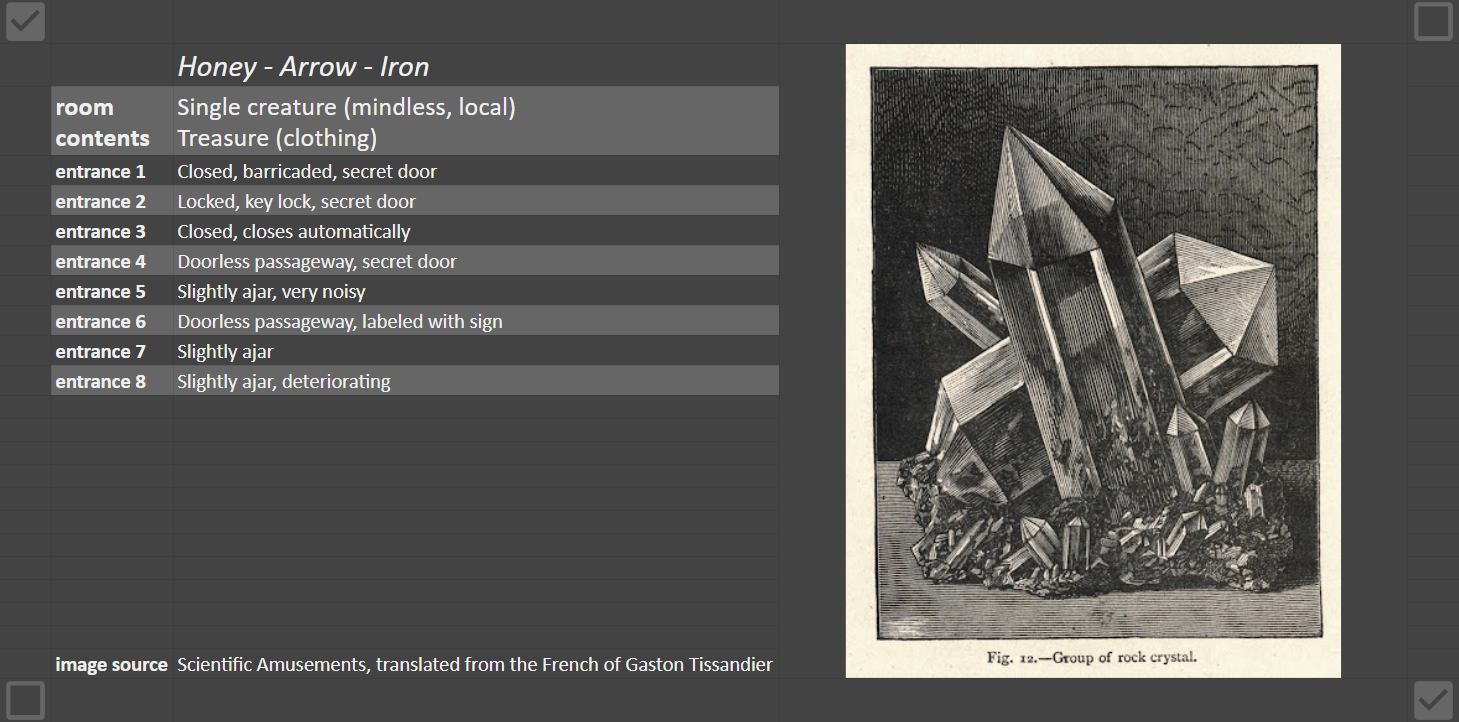
Okay, so as I mentioned last time, I'd been wanting to make a tool for randomly stocking dungeon rooms. And now I've finally got that done!
Dungeon stocker
Or, you know, done-ish. In a fully functioning state. But naturally I've got ideas to add more stuff to it later.
Anyway, here's how the thing works. First, as always, you make your own copy of the spreadsheet so that you've got edit access. Then, when you're looking for stuff to put in a dungeon room—I'm imagining that you've already got an unkeyed map—you just click one of those checkboxes in the corners. That'll reroll all the randomized bits. (That probably seems like a weird method to some folks. The deal with these spreadsheet random generators, though, is that all of the random numbers get re-generated every time there's a change to any part of the file. And the most convenient way I've found to do that is to just click an otherwise meaningless checkbox.)
So, the output of this tool is, first and foremost, intended as inspiration rather than straightforward description. The string of three words at the top is just a spark to suggest details and color where necessary, as is the image. They might help you fill in what kind of room you're describing, what sort of creature or trap to place when one is indicated, etc.
Rooms
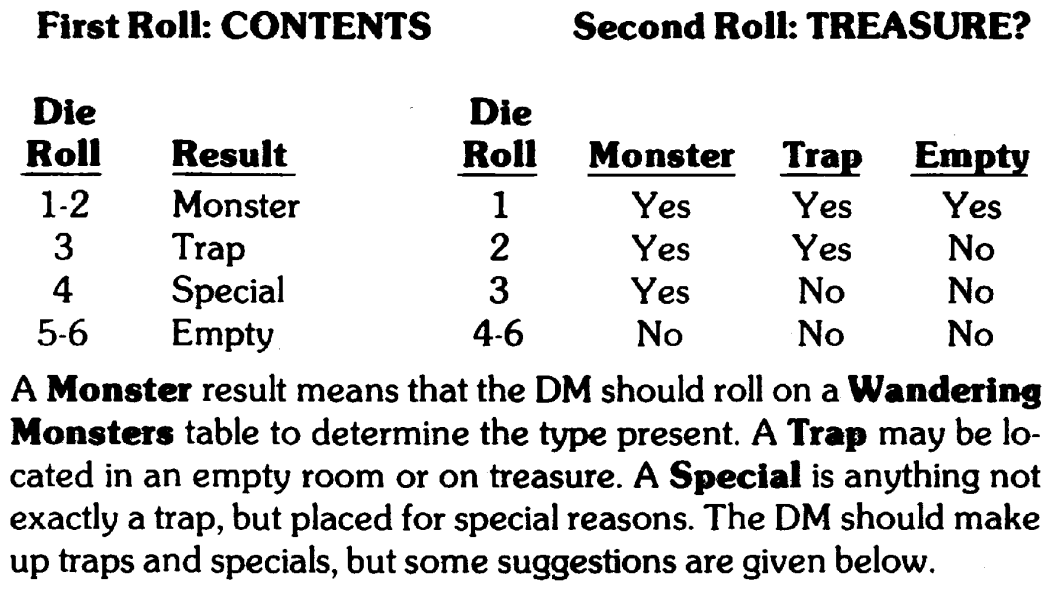
The "room contents" section is the important bit. It's equivalent to the old Moldvay "Monster / Trap / Special / Empty / Treasure" dungeon stocking rolls. I basically took the overall percentage chances for a room to have a monster, trap, treasure, or special feature (very much assisted by Alex Schroeder's work on this topic), and then turned those into separate rolls. That makes it possible for a room to have both a monster and a trap, for example. I also separated traps into both actual, intentional traps and the broader category of "hazards". And while all of these things can show up in the same room, there will also be lots of rooms where none of those major features are present. In such cases, the room instead gets some kind of minor feature, like clues about the dungeon's history or a source of fresh water.
Creatures
The creature results don't indicate specific monsters, but offer rough ideas to suggest options. I used the word "creature" rather than "monster" because communicative and even friendly NPCs could also be indicated by these results. "Multiple" should be interpreted as anywhere from two creatures to about as many as you'd expect in an adventuring party. "Many" means the party would probably be outnumbered. "Sapient" indicates that the creatures are basically people (in the broadest sense), "bestial" means they've got vaguely animal-level mentality, and "mindless" probably means they're some kind of undead, constructs, oozes, etc. "Local" creatures are native to the dungeon or otherwise connected to its history, while "invasive" creatures are more recent arrivals.
It could be handy to fit your palette of creatures into a matrix of these qualities. For example, if I was stocking a ruined tomb complex, I might categorize my recurring creature types like this.
| local | invasive | |
|---|---|---|
| sapient |
|
|
| bestial |
|
|
| mindless |
|
|
Then, if I get a "bestial, local" result, I'll consider making it a hungry dead or servitor ape. (I like to think that the latter were bred for obedience and facial wrinkles that resemble the cult's holy symbol. So they're mostly harmless but fucking hideous.)
Traps

The trap results indicate the trap's nature, its location, how many targets it can affect, and whether it can do that more than once. If the combined traits don't suggest a plausible trap to you, or if the spark words or image give you a better idea, just ignore whatever doesn't work! There's no game balance math at work behind those results.
Hazards
The distinction I'm drawing between a trap and a hazard is that the former is an intentional impediment while the latter is something accidental, natural, or random. Hazards are also a much broader category, so the generated details are pretty vague. I'd apply the concept of "hazard" pretty loosely, too: A flooded tunnel or swaying rope bridge that only becomes dangerous in conjunction with other troubles could totally qualify.
Treasure
The treasure results are straightforward and not very detailed. Maybe I'll make a whole treasure generator thing some time and plug it in here.
Special features
The "special" room result on dungeon-stocking tables always struck me as unhelpfully vague, but it's also an opportunity to include the kind of fun stuff that really makes dungeons memorable. This is where you'd put all those great dungeon toys that fulfill the "Something to Experiment With" entry on Arnold K.'s checklist. Oh, and as long as I'm linking: There's a great article on special rooms over on Beneath Foreign Planets (which also links to great articles from Clerics Wear Ringmail and Traipse). I really should have stolen all of Rook's ideas for my special feature table.
Anyway, I preface my special results with "consider" because I really don't want to be prescriptive with this category. Not every dungeon is the right place for a cloning device (even loosely interpreted), so maybe consider the suggested feature, look at the spark words and image, listen to the song of the universe, and go with your gut.
Minor features
Rooms that don't contain any of these major features—creatures, traps, hazards, treasures, and special stuff—are the equivalent of Moldvay's 2-in-6 "empty" rooms. Of course, they're not literally empty—Chris McDowall did a cool article about that—so I put some set dressing and non-treasure resources on a "minor feature" table that tries to add some detail to such rooms. I think so-called empty rooms are a good opportunity to emphasize your dungeon's themes or plant clues to its backstory. I included an "environmental storytelling" entry on my table, and I presume everybody's familiar with that video game term. Then I also put a lot of more specific things like (graffiti and corpses) that can be part of environmental storytelling. As always, where the results are vague, consider the sparks and image.
Entrances
After the room contents, we've got doors! Or entrances, really, since some might turn out to be missing their doors, or even just be literal holes in the wall. Anyway, start from "entrance 1" and go clockwise around your room or whatever, assigning details to each doorway. If you've somehow got more than eight entrances, just reroll.
This section is mostly about determining which doors are locked and what kinds of locks they might be. It's also possible to find out that there is a lock on the door but it's not closed all the way, or the entrance has been barricaded, or the door is hidden, etc. I didn't include traps here, though. Trapped doors are already covered in the room contents section, and I figured rolling for traps on both rooms and each individual door would make things too trap-heavy.
To clarify, "latch" locks include anything that is only (easily) unlockable by somebody on the right side of the door. This is the simplest kind of lock, of course, since it includes stuff like door bars.
The "hidden mechanism lock" is just supposed to indicate doors that are unlocked by some hidden switch, or possibly a lever or something in another room. Classic for secret doors, of course, but just as applicable to obvious ones!
"Obstructed" doors are blocked from opening (or possibly closing) by some random impediment like a barrel, a corpse, or a rampant patch of fungus. "Barricaded" doors have been deliberately obstructed, probably by somebody piling furniture or something against them. It's also possible for obstructions and barricades to be present where there isn't even a door, in which case they're just blocking passage.
I almost put in a random roll for which side a lock, obstruction, or barricade is on, and maybe even which way it swings open, but I figured those are better decided based on context.
Images
This is the fun bit, but probably the least important one. All of the images in the list (so far) came from the extremely cool and useful Public Domain Image Archive (itself a project of the excellent Public Domain Review).
I tried to include a wide range of images, focusing on things from which multiple meanings could be extracted. Or which just looked cool. If absolutely nothing else, they at least make the act of repeatedly reloading a spreadsheet more interesting!
Naturally, I'd like to add more stuff later.
