

Reimagining the elemental planes
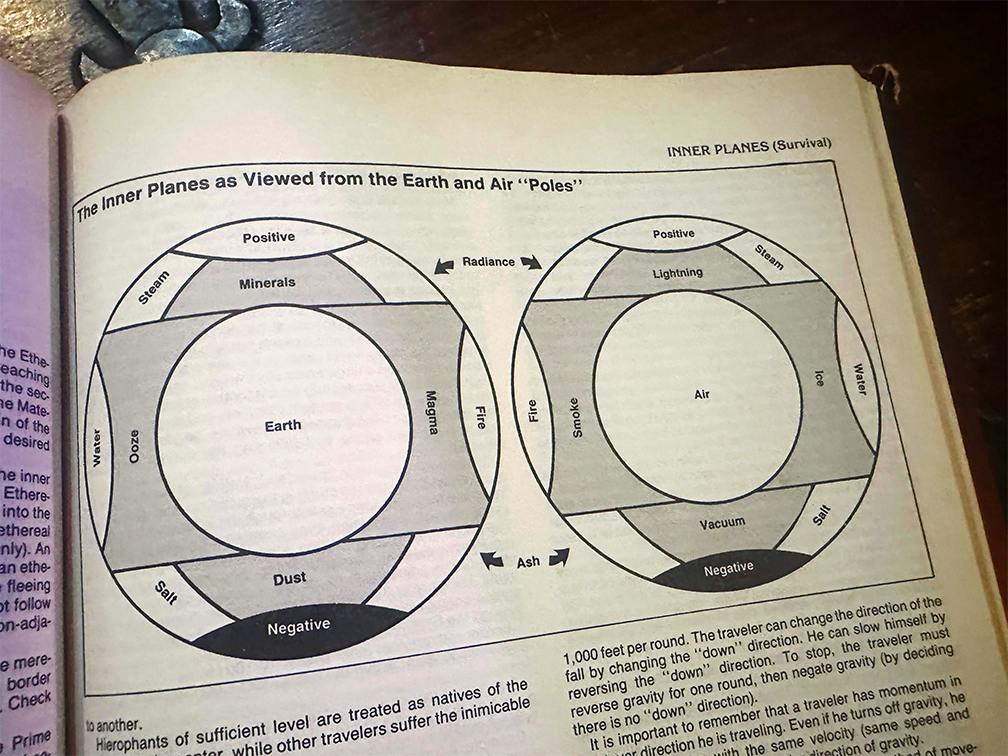
I think D&D's elemental planes (as I recall them from the old Manual of the Planes, anyway) are simultaneously too alien to be easily gameable and too boring to be worth the effort. Reworking them into more survivable, comprehensible places that express and exemplify their elements rather than just being wholly composed of them could be cool.
(Yeah, I'm sure they already fixed this in later editions. I kinda never absorbed setting fluff past 2e, though. My head is full of TSR-era lore and WotC-era rules. So I'm gonna just do this myself and pretend it's original.)
It might be even cooler to scrape off their serial numbers and ditch the idea of an orderly pseudo-Medieval/Classical elemental cosmology all together. So, instead of that fiery world being the Elemental Plane of Fire (where all of the fire-themed monsters live), it's just a fiery alien world which can have characteristics and relationships outside of that whole symmetrical paradigm.
For that matter, this idea could also be applied to "elements" that aren't in the AD&D elemental / para-elemental / quasi-elemental list. You know, like a blood plane or a sword plane. And it might even work with some of the Outer Planes! At least some of those actually have totally cool presentations that are only held back by the mythological mishmash of their names and the unnaturally orderly, alignment-centric cosmology of the Great Wheel.
...But I've got plenty to think about with the regular elemental planes, so let's see if I can do anything cool with them.
Air
The Plane of Air is already the most survivable and gameable elemental plane, and it's frankly not even that boring! I'd leave this almost unchanged.
It's a big, air-filled space with loads of floating motes of various sizes, some stationary and some orbiting other objects. Gravity is kind of local, so that small islands have way more pull than you'd expect, but you can still jump from them and shoot into the void. The whole place is lit and warmed by loads of little suns of various colors, so some amount of light is pretty much everywhere all the time. It's also really colorful: The distance haze effect isn't always blue, depending on local conditions, and nebulae of various hues stretch across the sky.
Life here looks a lot like that of Earth's pelagic zone, so loads of things like huge fish, arthropods, and cnidarians swim through the air. Loads of them are transparent, even nearly invisible, and they tend to have great vision (even the jellyfish analogs). Island life varies locally, since it can be very isolated. Plants are everywhere, but small islands might have very little animal life. There are also trans-island animals (like birds and flying insects) that mostly live on islands but can flit between them.
Earth
This is another plane where the original portrayal wasn't bad, but just kind of not enough. Instead of just occasional vacuoles of air, this plane needs to be honeycombed with tunnels!
So let's say the plane is a vast expanse of stone, all in various uneven strata, and possibly including some fantastic materials. Gravity is constant and Earth-like, and there's a universal "down". There's plenty of heat from magma and gas fires, so some areas are warm or even hot, but others can be damn cold. There are loads of vast caverns full of air and life. These typically have a layer of fertile soil at the bottom, and some are lit by sun-like orbs of flame, while others are dark. They're connected by smaller natural caves, mazy tunnels left by eons of burrowing creatures, and even hallways, shafts, and staircases created by intelligent beings.
Most life forms tend towards huge, worm-like burrowers and smaller invertebrates that live in the tunnels and debris they leave behind, both categories tending to be blind. The big caverns, however, have very distinct ecosystems: The lightless ones feature the powerful eyes and bioluminescence of Earth's abyssal sea creatures, while the sunlit caves have moss forests and much more surface-like animals.
Fire
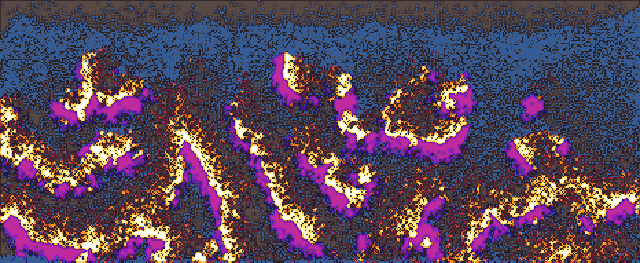
The Fire Plane is probably the worst one in the Manual of the Planes. I could seriously never imagine it in a way that really worked for me.
Instead of an infinite volume of Just Fire, Only Fire, In All Directions, we've got a vast plain. Some percentage of the plain is always on fire, but these fronts move endlessly, consuming regions of dry grass, brush, and scrubby little trees, and leaving behind a layer of fertile ash, already sprouting new growth. From a great distance above, the burning plain would look like one of those falling sand games where some short-lived, self-propagating element with a name like "virus" or "???" has gotten loose, sweeping over everything in chaotic but ultimately balanced waves.
There are some places on the plain that burn forever, because they're flaming pools of petrochemical sludge. Maybe there are occasional lava eruptions, too. And there are places that never burn: bodies of water, stretches of barren sand, and rocky ridges. Sometimes there's rain. Frequently, there are hot windstorms of sparks and ash. There's no sun in the sky, but there's never any lack of light or heat.
Life on this plain is mostly small, swift animals—things analogous to mice, grasshoppers, sparrows, etc.—and small, fast-growing plants. Lots of animals (especially the larger ones) are burrowers. The lakes hold remarkably ordinary fish and amphibians. The intelligent inhabitants build underground, or in the sandy and rocky places.
Water
An infinite volume of water is less interesting than a vast sea with an actual surface. With a surface, you can have boats and islands and storms. So this plane has a surface. No bottom, though. You can just dive down and down and down, getting darker and colder, the pressure increasing until the water becomes ice.
The depths are, of course, full of every imaginable kind of sea life. There are even coral reefs of a sort, despite the lack of a sea floor: Neutrally-buoyant detritus like algae masses and giant mollusk shells accrue layer after layer of sessile life as they drift and bob through the water.
Something similar happens on the surface, too: Floating islands form by accreting around tangled forests of buoyant trees and algae mats, potentially extending miles in diameter and gathering thin strata of soil. These islands develop their own quasi-terrestrial ecosystems, birds being especially prevalent.
The intelligent inhabitants (the air-breathing ones, anyway) build on the islands and construct sprawling raft cities, as well as boats of every size and description. They're never wholly safe from the leviathans of the deeps, nor the plane's monstrous storms.
Ice
Like a nightmare vision of Antarctica and its surrounding sea: a patchy mix of jagged mountain ranges, dramatic ice formations, bleak snowfields, and mazes of ice-crusted water, extending endlessly in all directions. The weather is characterized by relentlessly howling wind and the occasional obliterating snowstorm. There's no real sun in the sky, just an infinite and monotonous flat whiteness.
There's barely a scrap of plant life, and few animals either—more under the icy surface of the water than on the snowy land. There are some shockingly large and dangerous animals, though: giant white bats, tusked whales, shaggy carnivorous anthropoids, amphibious sharks, wolves the size of polar bears. The few people living here are hardy, practical folk who subsist primarily by hunting things that could easily kill them, given half a chance.
And somewhere in this icy waste—far from every settlement and planar gateway, but not far enough—there's an imprisoned horror. It's a dark mass of tentacles, massive and towering, frozen solid in the act of reaching skyward. It's more than half-covered in ice and snow, and it looks for all the world like a colossal statue of black stone until it's examined closely. It's something like the Thing or a shoggoth. Maybe it's the progenitor of every mimic and doppelganger. If someone were to so much as chip a piece off and take that fragment to a warmer, more populous world, the results could be cataclysmic.
Magma
I'm sorry to report that the best possible Plane of Magma has already been created, and it's the Nether from Minecraft. So I'm just going to riff off that.
This whole plane is an infinite volume of chaotically-arranged solid rock, molten rock, and surprisingly breathable air. It's hot as hell, but not as hot as the inside of a volcano. The pools and cascades of lava don't radiate heat quite the way they would elsewhere: They'll incinerate you on contact, sure, but you can stand pretty close without being cooked. Most of the solid stone here is porous red-brown stuff with an extremely high melting point, but alarmingly brittle and friable. There are also familiar volcanic materials like basalt and obsidian, great drifts of dark ash, crystal formations that emit a dirty orange light, and deposits of minerals that are combustible or even explosive. That's one of the most perilous things about this place: Sometimes, a big chunk of rock somewhere will just explode, shattering lots of the fragile red stone, causing a nearby lava flow to be redirected.
Of course, there's life even here: sessile chemotrophs, metallic geovores, even things that generate energy from heat gradients. Most of it looks vaguely like abyssal ocean life: lots of worm-like things, crab-like things, vague blobs. There are even blind, metal-skinned lava-swimmers shaped sorta like fish. Virtually all of these creatures are too alien and specialized to be interested in eating creatures from a more Earth-like world, but they could still be dangerous to be near.
There are intelligent inhabitants, too. They build sprawling fortresses from a dark purplish, heat-resistant composite material, and they're experts at manipulating magma for industrial and defense purposes.
Ooze

I always figured the Para-Elemental Plane of Ooze was clearly supposed to be about mud, since it's essentially the transitional realm between Earth and Water. But the word "ooze" has a lot of more interesting meanings! Obviously, there's the whole class of amorphous D&D monsters. But there's also the mutagenic ooze of Teenage Mutant Ninja Turtles fame! Plus the whole not-unconnected category of slime-based toys from the 1980s to (I guess?) the present. (And apparently there's also ooze candy? And vape pens or something? And that makes me think about The Stuff, that goofy '80s horror movie about an addictive, parasitic, corrupting dessert food—which I still say is a much better concept than folks ever realized.)
Anyway. This place is a lumpy expanse of fractally bulbous structures, most of which are covered in puckered apertures that frequently weep—or gush, or erupt—various kinds of slime, sludge, and slurry. The structures are tough and rubbery, mostly brown, gray, or dull purple, often mottled. Everything here is some level of slippery and/or sticky. Below the surface, the terrain is a complicated network of sacs, vessels, membranes, and fluids, all pulsing and flowing like the viscera of a single immense creature. However, it's all an ecosystem of interconnected colonial organisms coexisting in a slow and complicated dance of shifting symbiosis, competition, and manipulation.
And much of this activity leads to the production and expulsion of various goopy semisolids. These materials tend towards the green-yellow-orange-red part of the spectrum, and vary in viscosity from mucosal to gelatinous. Many are caustic, edible, narcotic, mutagenic, or some combination of those traits. A few are luminescent, and some are even animate.
In some places, whole expanses of surface material have died—the mark of microbiological wars decisively lost. These areas dissolve into soft, deflated films of tissue, and will easily split to dump a careless traveller into the internal muck.
The slime-spewing terrain isn't the only life here. There are loads of bird-like things that sip nutritious effluents (or tear chunks from the outer skin) while avoiding dangerous emissions, colonies of newt-lizard things that live in slime that would dissolve other creatures, huge worms that hollow out dripping homes in the surface structures. The intelligent inhabitants have learned to manipulate the oozes both chemically and ecologically, practicing a kind of living alchemy.
The brownish sky is lit by vast, roaming, sun-like orbs of white fire. They cruise high above the slimy world, disturbing the firmament into fluid psychedelic whorls as they pass. There are enough of them that any given point of the surface will effectively be in twilight most of the time, rarely fully lit, and almost never fully dark.
Smoke
Generally, the most interesting thing smoke can do is deliver psychoactive chemicals to a body. I guess a distant second would be its role in "smoke and mirrors" obfuscation and trickery. And then we've got incense smoke and signal smoke kinda tied for third place.
So, this plane's terrain is mostly gently rolling hills covered in forests of thin, graceful trees and sparse grass. The foliage is shades of gray, dusty purple, and soft pink. Pale smoke simmers up through the dark earth from endless, naturally occurring pyrolysis of vegetable and fungal matter below—just a few thin wisps in most places, and great roiling gouts in a few. Very occasionally, crevasses and sinkholes open up, exposing the hot, soft depths and releasing clouds that are visible for miles.
The smoke's composition varies from one place to another, but it generally smells pleasant and resinous, very much like incense. When inhaled by non-native creatures, it can be disorienting, soporific, analgesic, euphoric, and even hallucinogenic. It's thickest close to the ground, so visitors that lie down in the forest risk falling asleep for so long that they die of dehydration (if they don't die of oxygen deprivation first). Creatures that fall into sinkholes are often paralyzed and slowly mummified, experiencing ecstatic visions all the while.
During the day, the sky is a bright silver-gray vault with the slightest rainbow pearlescence. At night, it dims to reveal stars like scattered jewels swimming in a shifting, distorting haze.
Local lifeforms are wholly or completely immune to the effects of the smoke. The animals tend towards familiar terrestrial types like mammals, reptiles, and birds, although often rather gracile and pastel-toned. There are also a number of remarkably large and wildly colorful invertebrates. There are very few burrowing creatures, due to the heat of the soil's burning layer.
The people here manage their smoke exposure by building their houses on stilts or in the trees. Wooden walkways are common, as well. They wear gas masks and goggles on long journeys or when they dig to unearth naturally carbonized charcoal. They know where safer and more useful smokes arise, and understand the subtle seasonality of their emission.
Closing comments
Okay, that's plenty for now. Maybe I'll do the quasi-elemental planes another time.
I definitely kinda got more into it once I got to the para-elemental planes, and the primary four seem underdeveloped in comparison. I'd definitely give those another pass if I was ever going to do anything with them.
I'd also rename everything, of course. But that's definitely an exercise for another time.
