

Tiny hex map: Eastern Territories
My Eastern Territories setting needs kind of a lot of development, so I reworked my tiny hex map generator into an Eastern-Territories-specific variant. In the process, I learned that I really do need more monsters and factions, and to come up with actual names for some of the setting elements I do have.
Anyway, it's enough to help me try out my basic conception of the setting. So, here's what I got on my first roll.
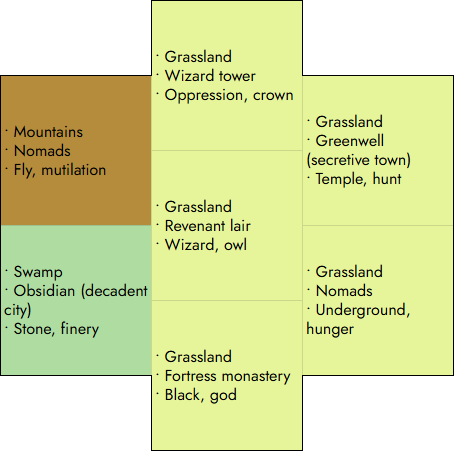
No dungeons at all! So naturally I'll interpret other locations as potentially dungeony. And I've got two hexes with "nomads", which I'm not necessarily interpreting as truly itinerant peoples, but maybe just extremely rural populations, and very possibly refugees from the general breakdown of the regional order.
I belatedly realize that I really should have set my center hex to "forest" instead of "random": The Eastern Territories are intended to be a pretty heavily wooded region. Oh well, I guess there are plains somewhere—especially to the north, where the land eventually transitions to savannah and desert.
North hex
Combining "wizard tower" with "oppression" and "crown", it's clear that I've got a wizard (or even a group of them) dominating and exploiting a local population, or even exerting power on nearby hexes. I really dig the idea of portraying this as a dire and toxic version of a magus covenant in Ars Magica.
There are several—say four or five—wizards here, and an equal number of non-magical companions (assorted warriors and experts, all PC-equivalent threats), plus a bunch of no-name guards and servants. Maybe they don't have a literal tower, but instead a big old house—something stony and gothic, but not quite a castle. Rambling with late additions and outbuildings, bristling with weathervanes, telescopes, and lightning rods.
The house—called the House of Thorns because it's choked with stinging ivy—dates back to the Empire of Flowers' never-quite-cemented conquest of the Eastern Territories, hosting a succession of imperial wizards, wealthy private sorcerers, and—most recently—teams of magicians from the School of Five Suns. Around that, there are a village and a few associated farms. The village grew up around the House of Thorns in the subsequent decades, so it never had a name of its own.
Maybe about a thousand people would live here in normal times, but the chaos in the Territories has caused people from the surrounding countryside to pull in towards it, and a few caravans of people fleeing petty wars have ended up here as well. The population is now at something like 1,200. Food will be a problem soon, and sanitation already is. But public order is largely not an issue, because the wizards have clamped down hard. They've distanced themselves from their Five Suns employers, they're ignoring the local powers that would call themselves the inheritors of imperial authority, and they've openly declared sovereignty over the village and everyone in it.
Now, unrestrained by school or empire and seeing warlords and worse impinging on all sides, the House of Thorns wizards are indulging in increasingly unethical experiments to secure their power, and the villagers and refugees are being treated as raw material.
Northwest hex
These mountains are home to an outcast tribe of territories folk. They call themselves the Attibus family. They became an embittered pariah clan through a series of conflicts with neighboring populations before the Empire of Flowers pressed this far east. When the empire came with their "divide and rule" doctrine, the locals took the opportunity to sell the Attibus as a bandit clan, which worked so well that they retreated further into the mountains and became exactly that.
Over the generations, they've become increasingly isolated and inbred, and the pantheon of ancestral saints they revere has been dominated by one of their number: the demanding and erratic Grandfather Hule. Life in the Attibus family got worse and worse, and young members frequently ran away to anonymously find a place in some settler town or with a less fucked up bandit group. Hule stopped that by instituting tribe-wide facial mutilations that permanently marked them with their origins.
From that point, the clan's reputation went from murderous hillfolk to half-legendary monsters: the Split-Faces. Grandfather Hule's tyranny became worse, and he spiritually consumed two other family saints. The Attibus are now committing cannibalism and stealing the children of lowland tribes to raise as their own. The mutilations progressed from a vertical scar on the forehead to a gash that ruins noses and lips. Their camps crawl with filth and vermin. Sickness and madness are constant. The clan is a factory that creates human wreckage for the glory of their ancestor and tormentor, Hule, while the other remaining family saints rot away in shame and silence.
Northeast hex
Greenwell is a prosperous market town of both western settlers and Territories natives at the center of several farming villages. As the empire's grip on the region has been replaced with a rising tide of warlords, bandits, cults, and mercenaries, this town has managed to keep it together. They took over tax collection in the surrounding villages early in the collapse, and picked the right armed groups to pay protection money—currently a company of ex-imperial soldiers called the Lucky Bastards and a nomadic Territories clan named Saylif. They also mobilized their own people into a part-time security force to keep an iron grip on local order and maintain their hold on the farms.
A significant amount of Greenwell's success is the result of their primary local god: an idol called Golden Hands that was created in the imperial capitol but awakened out here in the Territories. The settlers fast-tracked its growth by sacrificing criminals upon its massive, upturned, gold-plated palms, and they got excellent results from this (technically forbidden) method. The town keeps no secrets from the idol's priests—neither in its basements nor its citizens' hearts—and the surrounding farmland has stayed productive even without fertilizers from Western alchemists.
But Golden Hands developed a taste for both the sacrifices and the desperate chases that often preceded them. So, at least once a month, an appropriate criminal is chosen and given the chance to run and escape the town's justice. Or else some outsider or unwanted slave is found, and offered a reward if they can evade the temple's guardians from one dawn to the next. And if the quarry is caught—as they typically are—they're brought back to the idol. The priests no longer bear the onerous duty of cutting throats: The idol's power has grown to such an extent that it crushes the bound victim with its own gleaming hands and evidently enjoys the task tremendously.
Center hex
The largest organization for the study and practice of necromancy in what was once the Empire of Flowers is an officially nameless wizard society that people typically call the Quiet School. The reason it was historically so quiet is because of fiascos like the one that happened here.
Back before the School of Five Suns owned the House of Thorns—even before the empire was really serious about claiming territory this far east—a lone wizard used the house as a place to experiment with necromancy outside the strict regulations of the imperial heartland. Intending to do some extra work up front to save herself much more work down the line, she created a colossal necromantic construct that would gobble up corpses or even disorganized bones and process them into complete, animation-ready skeletons, rearticulated with live bacterial membranes and conveniently wrapped up in a fetal position with a papery caul.
The necromancer called this creation "the Owl", likening her skeleton capsules to owl pellets, but it could hardly look less like a bird. It's a castle-sized assemblage of bones and leather, held together by brownish membranes. It looks almost haphazard in structure, but it's symmetrical, and it moves with a clockwork smoothness on its six huge legs. Its front appendage—impossible not to interpret as a head—telescopes like a fish's complex jawbones to exhume and swallow corpses.
As a construct, it was a masterpiece, and worked entirely as intended. Its creator turned it loose on an old battlefield and it provided her with a steady stream of skeletons . . . right up until she was exploded by a rival wizard for unrelated reasons. And it's continued to do its thing ever since.
But, with nobody actively clearing away all the rotten spiritual energy the Owl kicks up, the whole battlefield attracts swarms of ghosts and demons, giving them enough strength to animate the endless supply of ready-to-go skeleton kits. Many of them wander off to do whatever their hazy memories and degraded minds inspire, but a growing horde stays with the Owl, following it as it wanders in its mindless search pattern, even crawling inside its spacious works and riding it around. The area has been thoroughly excavated by this point, but many of the revenants take it upon themselves to kill whatever people or large animals they can find and throw them into the Owl.
Southwest hex
The city of Obsidian is one of the oldest imperial settlements in the Territories, and was one of the early success stories that made the whole eastward push sound profitable. It was founded in a sucking mire, on top of sunken ruins dating back to the Nameless Kings era. Its primary industry is the extraction of artifacts from those ruins, most notably huge amounts of the glossy black material from which they were constructed. This stuff is a mysterious artificial substance called kalobar, but it was the origin of the city's name via poetic license. It's shockingly durable, workable only through specialized magic, and valuable enough to convince thousands of people to move half a continent away from home and live in a swamp.
Obsidian proper has grown into a strangely imperfect replica of a western city: unevenly compacted, shoddy in many places, dripping with wealth and ornamentation, unusually cosmopolitan, brutally unequal, and all ringed with fancifully threatening kalobar walls in some long-dead colonial governor's idea of Nameless Kings style. Outside that is a huddle of secondary settlements, from shack-towns to suburbs to farms. A little net of well-patrolled roads connects all of these, and a larger, less patrolled road connects that to the Great Eastern Road, which goes west to the capital and east to the true frontier, then to the war front beyond.
The city is nominally ruled by an exarch empowered by imperial decree, and in former eras was effectively ruled by a series of correctors, agents from the capitol with authority to overrule or remove the exarch. These days, the exarch isn't empowered by anyone, and the current imperial corrector has never heard from the capitol. The real powers in Obsidian are the local detachment of the Territorial Guard (currently at half strength following a bloody mutiny and constant desertions) and the dangerously wealthy Star Spire Builders (the wizard guild who hold the secret of harvesting and shaping kalobar). Other factors include priests of the imperial cult (who revere the distant, distracted, divided ancestor-saints of the Rotha dynasty), the Assessment Office (who are legally supposed to receive and examine all unidentified artifacts from the ruins), a growing native resistance movement (currently nameless, but strong enough to hold territory within the walls), and the excavators (the hard-bitten workers who do all the digging and sometimes brave hideously dangerous ancient horrors).
Order and security have remained partially intact throughout the slow disintegration of imperial influence—with the exception of little hiccups like the aforementioned mutiny—but the injustices of imperial society can't persist without imperial might. Some casual wealth redistribution has started—through theft, vice, and rapidly shifting market forces—and the Guard permits the occasional lynching if a sufficiently large and determined mob forms to do the deed. Riots without a specific, limited target and a clear winning side are suppressed brutally, and the executions of both would-be revolutionaries and especially reviled criminals are both public and increasingly creative.
Southeast hex
Refugees from imperial settlements further east have come here very recently. Fleeing the tiny wars of ambition and vendetta breaking out in their old province—as well as the banditry they encountered on the roads—they've found themselves forced to take shelter in a subterranean tomb complex.
The catacomb dates back to the time of the Dawn Empires, but was used by other civilizations long before the refugees arrived. And its near a fairly major trade route, so it was rediscovered and partially looted years ago, but it sprawls over a large area, contains several levels, and is partially collapsed in many places, so it's still far from fully explored or exploited. Even the more accessible areas, while picked clean of all obvious treasure, contain murals, scrolls, and statuary of potential value to scholars or wizards.
The catacomb is warm, dry, and defensible, but otherwise not a great place to live. The collapsed areas are dangerously unstable, and residents often wake up covered in a fuzz of insects curiously tasting them. The refugees' most critical problem, though, is hunger: These people don't have the skills to hunt and gather enough food for their whole population. They ate and drank any remotely digestible grave offerings weeks ago. A few people have taken to hauling mummies out of the tombs and turning them into stew. More are turning to banditry.
The place is also still teeming with the remnants of ancient ghosts and tainted by the shattered and rotting enchantments that once protected the place from both looters and demons. Many of the refugees have been having strange dreams as unclean spirits gradually wear away at their defenses, seeking to possess or manipulate them.
South hex
A large and impressive monastery called the Omphalos has stood here in the plains since before the Empire of Flowers existed. It was built in the waning years of the Dawn Empires era by a wealthy clan from the northern deserts. Lured here by dreams and prophecies sent by a growing godling called Unen, they erected a temple on a contact point with the spirit world and mingled with a local tribe who already served that entity.
Over the centuries, the temple's role and Unen's worship have evolved, becoming more closed but exerting more influence over local populations. The Omphalos is now a monastery, its members focusing on spiritual practices within its walls rather than spreading the word or working the will of their god outside.
The monks are very strictly male—in fact, no women are allowed within the building—and are forbidden to marry or own property. They are, however, permitted sexual activity (with men or women) "as necessary". They take in (male) orphans, foundlings, and unwanted children, so their numbers tend to swell in times of strife. Inevitably, many of their new acolytes are the sons of other monks. The Brothers of the Omphalos aid local populations by suppressing dangerous revenants, ghosts, and demons, and are generally well respected by local communities, both the Easterners and Westerners.
The Omphalos itself is a round structure built from orange-brown stone, something like a squat, tiered tower with an open courtyard in the center. Its outer layer is ringed with walkways behind ranks of slender columns, and open staircases spiral up around its circumference to entrances on different levels. It gives an impression of dreamy aspiration, but it's sneakily defensible: The tiered walkways let a host of archers fire in any direction, and the external staircases are pierced with murder holes above hidden chambers for pikemen.
Below the structure is a vast natural cavern with access to an underground river. In this place, Unen has been using the power of the monks' worship to build themself a physical body. No light is allowed down here—the monks collect water in absolute darkness—but all the Brothers who have taken the second set of vows know all about it. It's a titanic, androgynous humanoid figure, its flesh hard as wood and cold as stone. It has four arms, and a smooth lozenge of metal in place of a face. Much of the upper half of the body—from the head to the upper pair of shoulders to the back—is covered in very long, dense hair. The shape is lying down—has been lying down for all the centuries it has grown here—but would be hundreds of feet tall if it stood up. It would also need to destroy the cavern ceiling and the Omphalos above to do that. In the light, its skin would be pale blue, its hair would be deep black, and its metal face would be mottled gold.
The body certainly seems complete, but Unen hasn't seen fit to inhabit it yet. The Brothers don't know what their god intends to do with it, if anything, and officially they don't worry about it.
Closing comments
Well, that one took me forever to do! The ideas are easy enough, but actually writing them up seems to be like pulling teeth. I probably should've just gone with a bullet point format or something.
Also, I'm realizing that I need to figure out some naming conventions for this setting. I like to just use English words most of the time, but some nonsense fantasy words occasionally seem necessary. I've got a rough idea of the languages used in and around the Territories, but I need to give them distinct sounds.
That said, the setting does feel like it works. I'm starting to understand it as its own thing rather than just a collection of references to other works. Definitely needs more development, though, just like I said up top.
