

Coin sizes and values
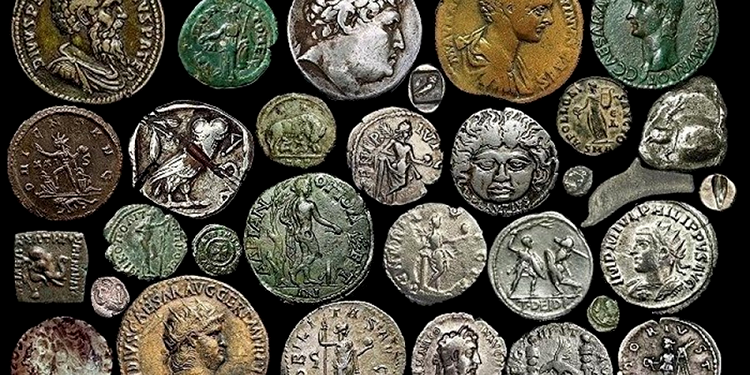
Okay, new obsession. I've suddenly found myself spending a lot of time thinking about D&D currency (in connection with that oldschool/newschool pseudo-retro hack I've been messing with, of course). And there are a whole pile of different factors influencing my angle, here. These include (in no particular order) the following.
- Real world values of standard fantasy coin metals
- XP for carousing
- Player expectations of what a treasure horde looks like
- How many pounds of coinage characters might have to haul around to buy an expensive thing
- Semi-realistic pre-modern prices for things derived from historical research
- Compatibility with adventures and prices lists made by other people
- The annoyance of tracking low-value cash
- Reasonably convenient coin sizes
- Starting cash and shopping during character creation
- The OSR silver standard
The silver standard
Actually, let's start with that last idea. It's kind of an assumed practice in some olsdchool/neo-oldschool/DIY RPG scenes right now that the default coins are silver, not gold. So values of things are given in silver, the cash-for-XP mechanics are balanced on 1 SP = 1 XP, dungeon treasures are light on gold, etc. There are a lot of different reasons given for this, but I think they mostly boil down to historical verisimilitude (folks didn't really throw around a lotta gold coins during the periods D&D mostly tries to emulate) and aesthetics (where silver just feels more fitting to grimy tales of desperate vagabonds and tomb-robbers). There are also some carrying capacity concerns, and the simple fact that it's just good design in a progression-focused game to start players off with low-value currency and let them work up to higher values.
The excellent Delta has had a lot of smart stuff to say on the silver issue, and this would be a good time to throw a couple links at you.
Anyway, I dig the silver standard idea! I'm not terribly concerned about historicity, but a vaguely verisimilitudinous vibe is nice.
Relative values of denominations
Speaking of history, though, let's do a quick D&D edition comparison. As you may be aware, the relative values of the game's standard coin denominations have changed over the years! Here are the values of one gold piece in each edition.
| edition | astral diamonds | platinum pieces | gold pieces | electrum pieces | silver pieces | copper pieces |
|---|---|---|---|---|---|---|
| OD&D, Holmes | — | 0.2 | 1 | 2 | 10 | 50 |
| B/X, BECMI, RC | — | 0.2 | 1 | 2 | 10 | 100 |
| AD&D 1e | — | 0.2 | 1 | 2 | 20 | 200 |
| AD&D 2e | — | 0.2 | 1 | 2 | 10 | 100 |
| D&D 3e | — | 0.1 | 1 | — | 10 | 100 |
| D&D 4e | 0.0001 | 0.01 | 1 | — | 10 | 100 |
| D&D 5e | — | 0.1 | 1 | 2 | 10 | 100 |
Oh man, I forgot how crazy 4e got with the 100-gp platinum pieces and the astral diamond space money.
Anyway, the point is that these values have varied wildly! I think there's been a general trend towards decimalization over time—even the reintroduction of electrum in 5e was sorta highlighted as not really being part of the normal monetary system—and that seems like a damned sensible move to me.
However, I now ask you to consider . . . centimalization.
This is, admittedly, not a word. But I think the meaning is obvious: What if we made the whole scale look like the upper end of the 4e progression, and valued each currency at 100× the previous one?
Now, despite the fact that I had to make up a word for this, it has in fact already been done, and by no less a light than World of Warcraft, in which 1 gold = 100 silver = 10,000 copper. And, knowing how shamelessly other MMOs have imitated WoW over the years, I expect that there are loads more examples!
But here's a more interesting example. I just checked the current real-world values on a site called Daily Metal Prices, and it turns out that an ounce of gold costs $3,379.92, an ounce of silver costs $37.85, and an ounce of copper costs $0.27. And, folks, those are close enough to 100× steps for me!
By the way, platinum is only selling for $1,318.40 per ounce! Less than half gold's value! Is that a modern development? Is there any historical basis for platinum's high value in D&D? Wikipedia says "During periods of sustained economic stability and growth, the price of platinum can exceed that of the price of gold. ... In the 18th century, platinum's scarcity, traits, and intrinsic value made King Louis XV of France declare it 'the only metal fit for a king'." So that's interesting.
Anyway. These are obviously modern numbers, and silver used to be a lot rarer than it is now, but I'm less concerned with history than with things just feeling right. So I'm really interested in trying out centimal currency denominations! At this point, I've watched enough dumb reality shows where people get very excited about a few yellow pebbles to feel like a whole coin made out of gold should be worth a hell of a lot.
Coin size
But just what is "a whole coin", anyway? Would you believe the answer to that question has also varied from one edition of D&D to another? But it seems to be a much simpler story than the wild journey of coin values. As far as I can tell, all coins (regardless of denomination) started off weighing 1/10 of a pound each, then switched to 1/50 in AD&D 2e, and that's where they've been ever since. (That's what one source I found said, anyway. I couldn't find any mention of coin weight in 2e. So maybe it was really 3e when the 1/50 lb. thing showed up.)
Just for kicks, let's see what coins of those weights would be worth today.
If we're going with the modern 50-per-pound coins, a copper piece would be worth 9 cents—which ain't bad, given that it's only 3.6 times the weight of a penny. A silver piece would be $12.11, which honestly makes the silver standard idea sound very reasonable. Finally, a gold piece the size of a fat penny would be worth $1,081.57, which certainly lines up with expectations calibrated by all of those gold grabber shows.
Obviously, if we use the old 10-per-pound coin weight, everything works out to five times as much. A copper piece would be $0.43, silver would be $60.56, and a single damn GP would be worth $5,407.87. I'm not going to calculate how many of those it would take to make a proper horde for a dragon to sleep on.
Anyway, since we know the weights of these coins and the densities of their metals—I'll leave alloys out of the question—we can find their volumes really easily.
| copper | silver | gold | |
| 1/10 pound | 5.077 cm3 | 4.319 cm3 | 2.352 cm3 |
| 1/50 pound | 1.015 cm3 | 0.864 cm3 | 0.470 cm3 |
Then, with these volumes in mind, we can figure out how big these coins might actually be. I think the easy way for me to do this is to just start with some familiar United States coin sizes and work out how thick our fantasy money would have to be to hit those same diameters. I'm going to use the diameters of the dime, nickel, quarter, half dollar, and silver dollar, since they represent a good spread of sizes. This calls for an infographic!
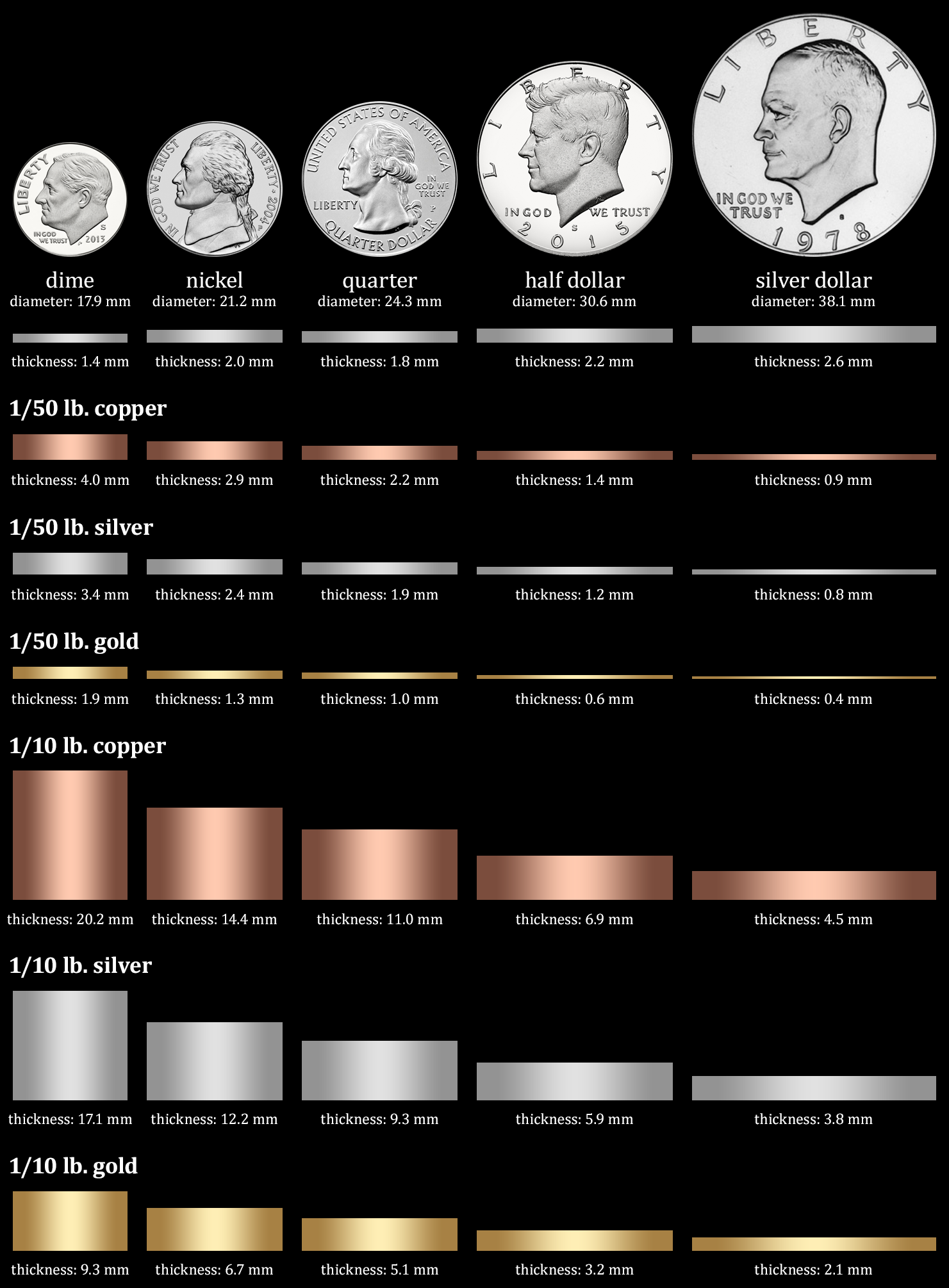
Obviously, a lot of these proposed diameter/thickness ratios are straight-up silly. Those really flat 1/50-pound gold coins would be crazy bendable, while the small-diameter 1/10-pound coins would roll like barrels if you dropped 'em.
Honestly, most of those 1/10 arrangements are pretty goofy. I think the thick-as-fuck quarter-diameter gold coin seems really pleasing (if a little cartoony), but the silver and copper coins would have to be crazy huge to hit that oldschool coin weigh. They'd seem more like Olympic medals than money. It's hard to believe a society that produced such coins wouldn't also make much smaller ones.
I like the 1/50 scale better. In that paradigm, I'd go with the dime diameter for the gold piece, the nickel for the silver piece, and the quarter for the copper piece. Those seem like more reasonable, believable coins.
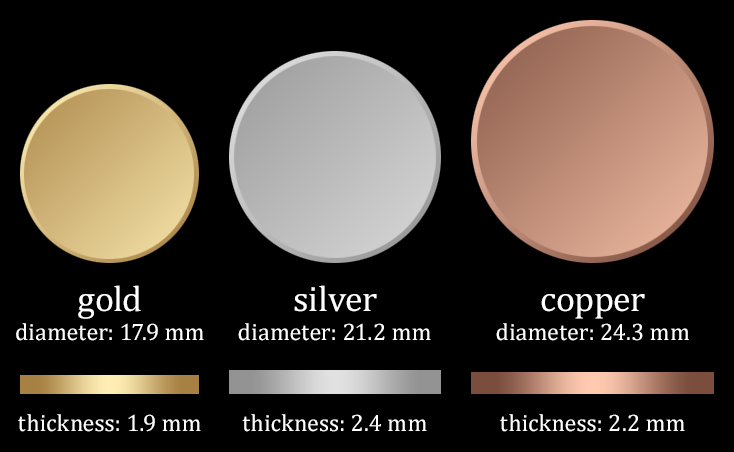
Again, I'm neglecting the whole question of alloys here. Coins throughout history have been quite famously not made out of pure, elemental precious metals! But it's a messy and indefinite area, and I'm not inclined to try factoring it in. Anything you'd alloy a coin with is likely to be lighter than the primary metal, so we can just assume that these coins should maybe be fractionally larger by some ignorable degree.
Purchasing power
So, the real issue behind this whole distraction is the question of what these coins should actually be worth in the game. As I said, I'd like it if their values actually approach something like the real world values of similar quantities of such metals. That's a lot easier to do with the modern 1/50-pound coin weight and the silver standard. I'm pretty comfortable rounding off their approximate purchasing power to something like $0.10 for a copper piece, $10.00 for a silver piece, and $1,000.00 for a gold piece.
Time for a couple more RPG blog links, this time from esteemed indie game designer Skerples.
In addition to a lot of cool ideas and research, Skerples describes a monetary scale in which a copper piece is valued at roughly $1.00, a silver at $10.00, and a gold at $100.00. I really like this, because it makes copper pieces feel more meaningful than they typically do in D&D, but my own current fixation on modern metal values would make it hard to adopt. As we established, even a giant oldschool copper piece would be less than 50 cents' worth of metal!
But Skerples offers another cool thing here, and that's a simplified D&D gear price list based on actual historical data from various sources (notably Kenneth Hodges and Steven Proctor, I think)! I'm always the first to announce that my D&D settings are emphatically not Medieval Europe, but it does seem like a really useful and verisimilitudinous set of benchmarks, easily translated from Skerples' decimal scale to my centimal one. If a torch costs about a dollar (equivalent), a sword is about 200 bucks, and a suit of plate armor is something like $10,000, that's something I can work with! The differing costs and availability between urban and rural markets is a cool touch, too. (I can't quite make sense out of those hireling wages, though. I think I'd have to rework those.)
Portability
One really nice thing about using something like real world values for silver and gold is that paying for expensive stuff won't often require whole cartloads of coins. If you want to buy a suit of that ten-thousand-dollar plate armor with silver, you only need to bring 1,000 nickel-sized coins with you. That'd fit in a pretty small sack. Or hey, how about the most expensive thing on Skerples' Medieval price list, the galley? That price would work out to $80,000. Pay for it in gold, and it's just 80 dime-sized coins! That's like belt-pouchy territory. But you'd be a fool to keep it somewhere so accessible.
Cash-to-XP conversion
Another factor here is my interest in using a carousing system for XP. Actually, that's just part of it, and some readers might not know about that kind of XP mechanic anyway, so let me start from the top.
The great strength of the whole XP concept—and the reason we see it deployed all over the place right now, including uses outside of game systems entirely—is its power as an incentive. If you want a player to do something, you make that thing reward them with numerical increases that build slowly but noticeably towards more tangible payoffs. Whatever the players need to do to get those rewards, that's what the game is going to ultimately be about.
If you want the game to be about fighting monsters, you award XP for killing or otherwise defeating monsters. If you want the game to be about looting dungeons, you link XP to recovering treasure.
The XP-for-GP system has an obvious side effect, though: player characters who become extremely wealthy over time. For various reasons—not the least of them being a preference for protagonists who are perennially broke vagabonds—that might not be ideal. So that's where the idea of "XP for carousing" comes in. The idea there is that you only get the XP if you waste the money. That is, you actually enjoy it, instead of spending it on sensible things. Generally, there's also a table to roll on, making it possible for all kinds of additional benefits or adventure-provoking problems to come out of your high living.
Personally, I love XP-for-carousing mechanics because they encourage players to have their characters act like real people instead of game pieces. But not everybody is playing a character who would want to spend all their money drinking and gambling and whoring or whatever. For some PCs, sensible spending is in character. So I'd like to include two more options besides carousing: training and magical research. They both let the characters turn cash into XP, but training would do it without the random table, and research would use a very different random table. There'd also be a special fourth option where you could have a funeral for a fallen PC and get a better return on your money than normal.
But all of that is stuff for a different blog post. Right now, I'm thinking about how this all fits alongside my intended cash values. If it takes, say, 2,000 XP to get to 2nd level, and my carousing system gives people 1 XP per silver piece spent, and I'm valuing silver at something like 10 USD per coin . . . then I'm requiring PCs to blow $20,000 dollars each on luxury degenerate benders at the start their careers. And the numbers just go up from there!
Folks, I am not a party person. I could be real far off in my party calibration. But that seems fucking ludicrous.
So do I decrease the value of a silver piece in spite of all that figuring I just did? Do I decrease the numbers on XP tables and give out way less treasure as well? Do I change my SP-to-XP exchange rate to something more generous (and also give out less treasure)?
Right now, I'm considering option 2. I feel like a 1-XP-for-1-SP carousing payout rate is nice and intuitive, so I don't want to mess with that. Instead, I could just start my level progression tables at something like 100 XP (effectively $1,000) to reach level 2. And I'd cut treasure payouts, but not quite as much as I'm decreasing XP requirements—say, 10% as opposed to 5%—since the PCs would still need to spend some money on sensible stuff!
So, let's say I've got an adventure module that was originally calibrated to get a party of four PCs from 1st to 2nd level. That would probably mean a bunch of smart, motivated players could wring about 8,000 GP from it. Under the silver standard, that would be 8,000 SP, and with my treasure adjustment it would be a mere 800 SP. The PCs would inevitably spend at least 100 SP each carousing themselves up to 2nd level, leaving them each with 100 SP. If I'm going to value plate armor at 1,000 SP, that's going to mean a lot more dungeon delves before anybody's clanking around in heavy armor. Or more likely they'll just loot some armor from somewhere.
Yeah, I think I'm okay with the sound of that paradigm.
