

Saving throws in oldschool D&D
Since that last post, I've been spending way, way too much time thinking about a B/X hack that I'll probably never actually use for anything. (I say "thinking about". I have literally written like 5,000 words about it.) Along with that, I've been looking at the save progressions in old D&D and wondering what the logic behind them might be. So, today I'm going to finally try to figure that out.
To that end, I'll check out the save mechanics in the same editions I looked at when analyzing attack mechanics: Original D&D, AD&D 1e, B/X, AD&D 2e, and the Rules Cyclopedia.
OD&D
Okay, looks like we're starting this one off with a bit of a wild ride.
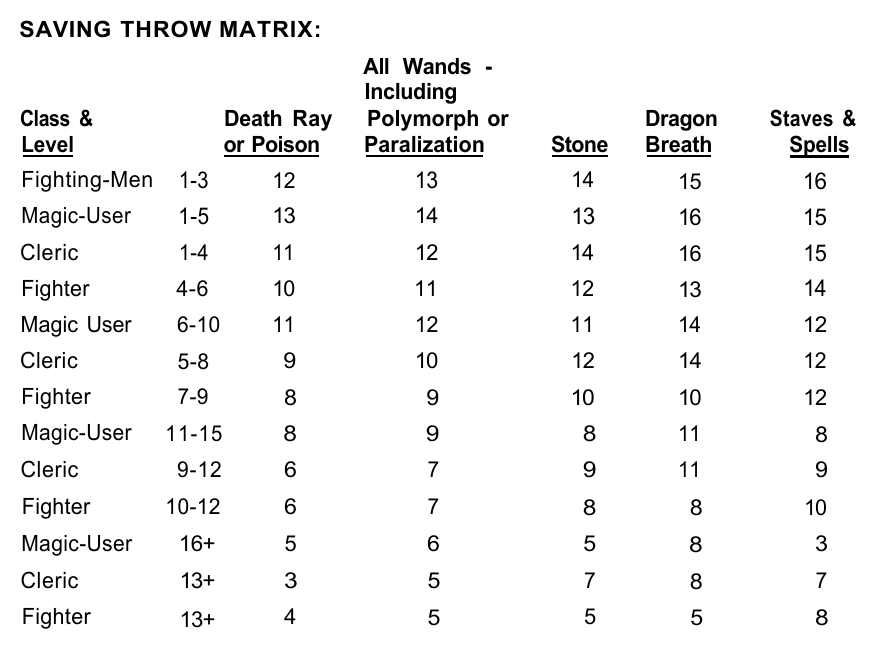
Wow, was page 20 of Men & Magic actually the place where D&D switched from "Fighting-Man" to "Fighter"? Seriously, though: Even compared to some of the gnarlier attack roll tables from oldschool D&D, I think we're seeing some pretty strange information presentation decisions here. The way they've got the classes mixed together makes analysis harder, and I can't imagine it was ideal for use at the table, either. So, before I do anything else, I'm going to sort the whole thing a little better.
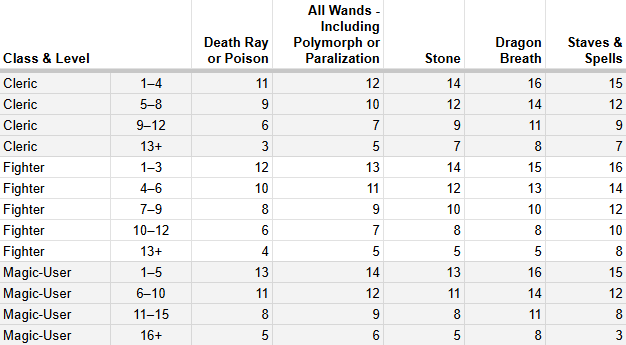
Just like with the attack roll tables from last time, these are target numbers for a d20 roll, so lower is better. And, also like a lot of oldschool attack progressions, we can see that the different classes advance at different rates: Clerics' saving throws get better every four levels, Fighters improve every three, and Magic-Users every five. And these are even the same rates at which their attack rolls improved, too! It's actually kind of amazing that the concept of PC power tiers only emerged decades later, because we're really seeing some blatant leaps and plateaus here.
But first, let's just compare the classes' starting points.
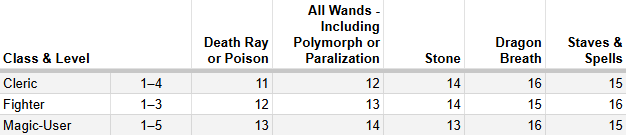
The Cleric broadly starts with the best saving throws, except for the Fighter's notable resistance to Dragon Breath. The Fighter is pretty middle-of-the-road, except for being the best at Breath and the worst at Spells. The Magic-User, finally, starts with the overall worst saving throws, except for their resistance to Stone. This does back up everything I've heard about how hard it is to keep MUs alive until levels where they start to be really effective.
It's also worth pointing out that we've got a clear hierarchy of difficulty between saving throws: Check out this quick-and-dirty chart where I just subtracted the "Death Ray or Poison" target number of each row from all of the other save targets.
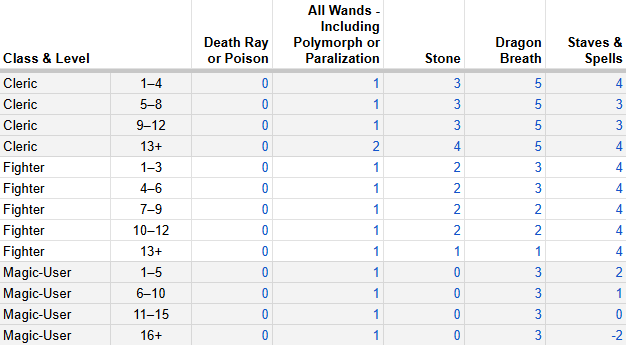
Death Ray is definitely the easiest one to make (except that Stone, oddly, is just as easy for Magic-Users). Wands is mostly just one point harder than Death Ray. Stone is mostly a little harder than that (except for Magic-Users). Dragon Breath is mostly the hardest saving throw of all, except that Fighters are notably good at it, especially at higher levels. Staves / Spells is a little weird in terms of difficulty, landing somewhere between Stone and Breath for Clerics, solidly topping the list for Fighters, and interestingly going from second toughest for low-level Magic-Users to even easier than Death Ray for high-level Magic-Users!
So what about the classes' actual progressions? I'm afraid those aren't going to make as much sense as the attack progressions did. Let's look at how much each save's target number decreases at each step.
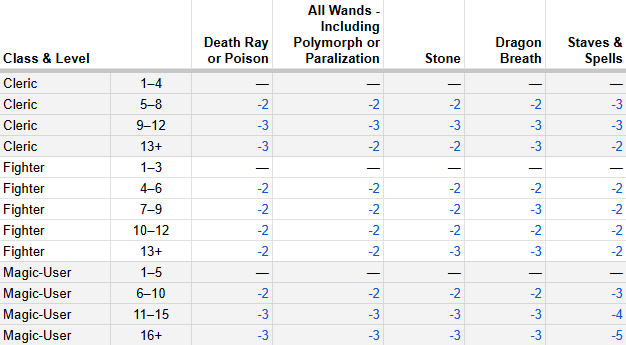
Yeah, there's some weirdness here. The Cleric's saves improve by two or three points each step, but not in any pattern I can recognize The Fighter's numbers are way more rational, improving by two points per step nearly across the board, except for that weird jump at the end of their Stone progression, and the fact that their Breath progression goes in a pretty reasonable 2-3-2-3 pattern. The Magic-User, interestingly, has something like a more rational version of the Cleric's progress: a predictable 2-3-3 pattern . . . except for that wild 3-4-5 acceleration of the Spells save. Man, you do not want to try tossing spells at a badass wizard, clearly. They will just shrug that shit off.
So, what do these progression rates average out to per level? I'll add up the total change, then divide that by the levels it takes to get there.
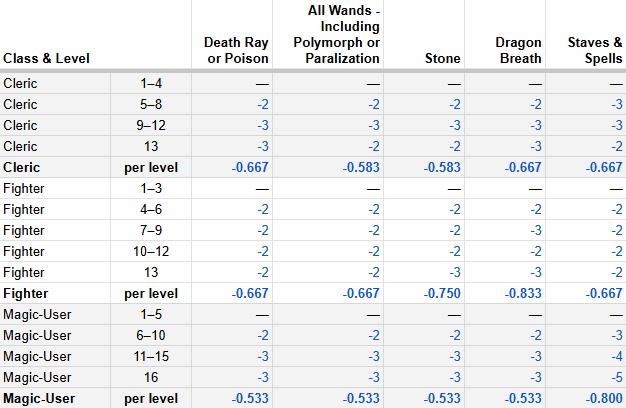
You know, for all the crazy variety of level plateaus and progress steps, the ultimate rates of improvement are surprisingly similar. Seems like you could just replace all of these with simple 1/2, 2/3, and 3/4 progressions.
Anyway, while oldschool attack progressions were perfectly sensible at the start and got straight-up baroque from there on (until 2e rationalized things), it turns out that saving throws were weird from the very beginning.
AD&D 1e
So three years later, in 1979, we've got the Advanced Dungeons & Dragons 1e Dungeon Masters Guide, and the rows are sorted by class! Much better!
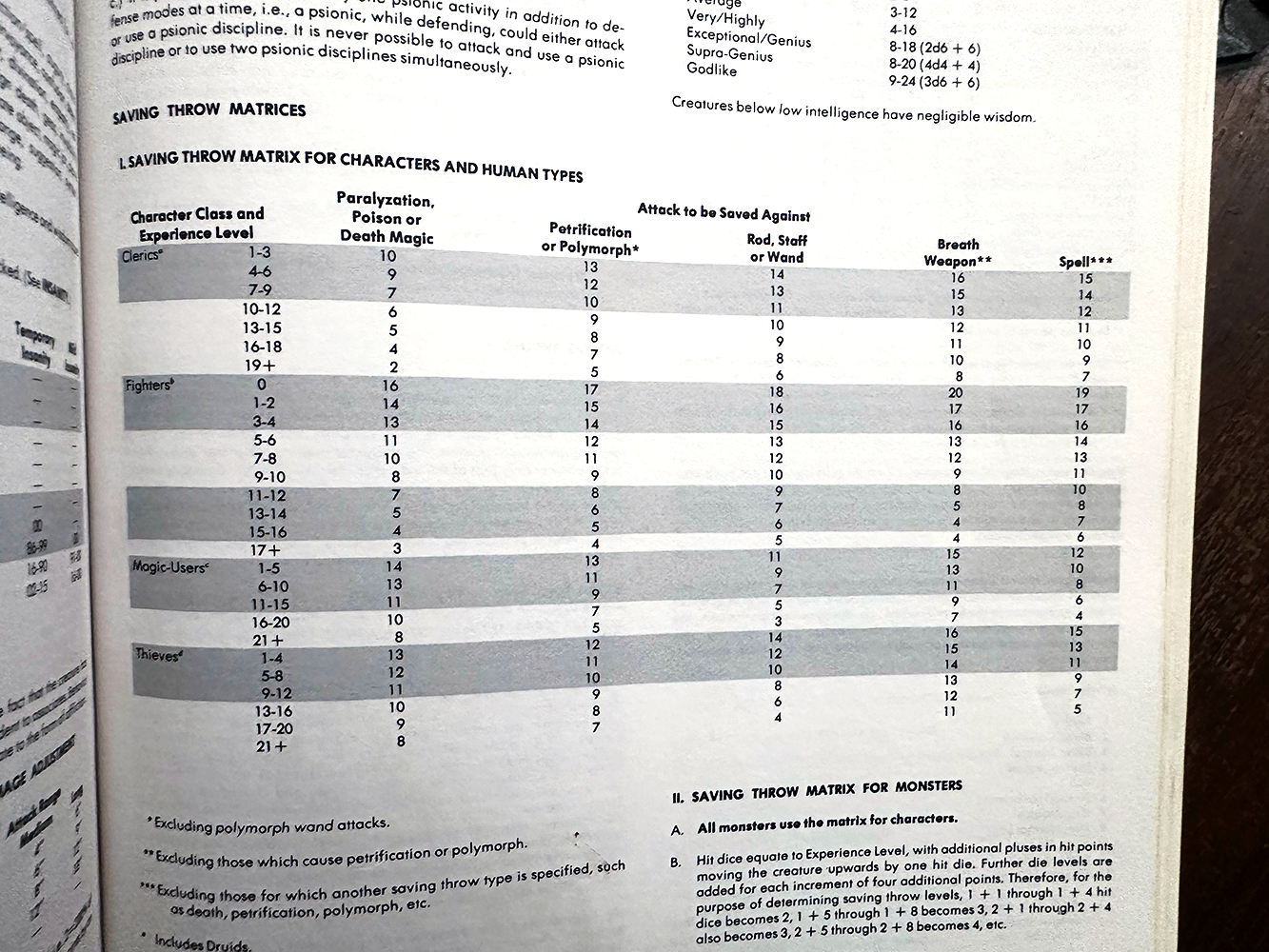
Okay, obvious stuff first.
- Paralyzation has been combined with Poison and Death Magic—which is interesting, because later that gets moved over to Petrification. I've never understood why it's "Paralyzation" and not "Paralysis".
- Polymorph is added in alongside Petrification, which I think makes sense: It's all about bodily transformation.
- The Wand save has been expanded to include Rod and Staff, taking Staves away from the Spells save.
- "Dragon Breath" is now "Breath Weapon", since I guess there are other things with breath weapons now. Gorgons come to mind. However...
- The asterisks on some of those categories are there to specify how category overlaps are handled: Saving against a wand of polymorph uses the Rod/Staff/Wand number, but saving against a spell or breath weapon that would transform you uses the Petrification/Polymorph number. This is messy and I am not comfortable with it.
- The Cleric and Fighter progressions have shorter plateaus, presumably to make room for the Thief: The Cleric's saving throws improve every three levels instead of four, and the Fighter's improve every two instead of three! The Magic-User's saves are still advancing on fives, while the Thief takes the Cleric's four-levels-per-step slot.
Again, I'll start by comparing the classes' starting points.
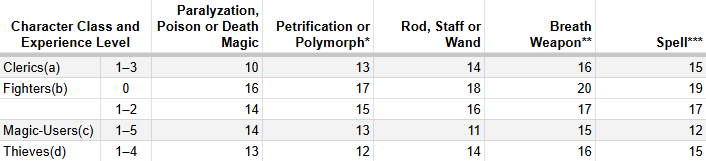
Interestingly, MUs are starting out a lot better off this time! In AD&D, they're good against Spells even at early levels, plus they're great against Wands. This makes me think that, at this point in the game's evolution, "Save vs. Wands" had not yet become a proto-Reflex save: Instead of being about dodging beams from magic items, maybe it's about resisting slightly weaker versions of spells.
Level-0 characters (somewhat oddly classed as Fighters here) are predictably the worst at all saves.
Surprisingly, even Fighters with actual class levels are in kind of a rough place, here: They don't start off better than any other class at any save! In fact, they're actually the worst against Breath! That's a shock.
Now, let's see if the saving throw difficulty hierarchy still stands.
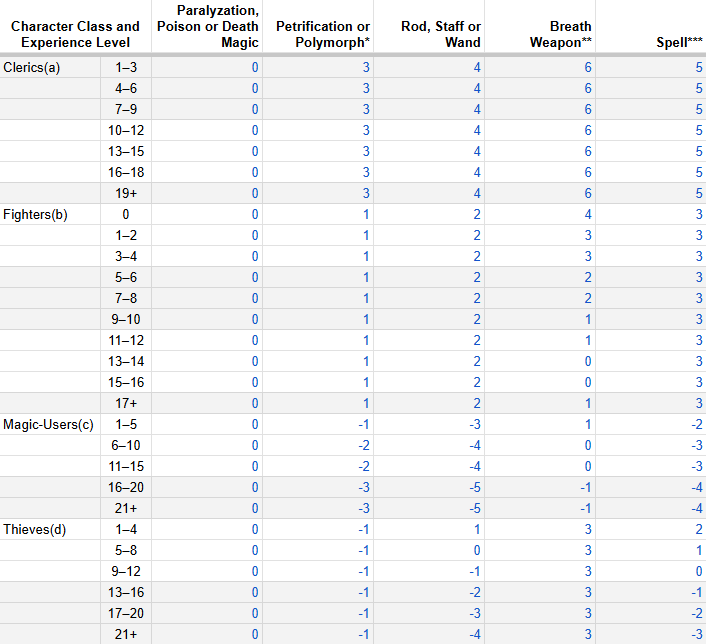
Looks like it's a little different this time around! Death saves are still broadly the easiest, but Petrification is now slightly easier than Wands—especially with Magic-Users and Thieves being even better against it than Death! Breath is still the toughest save. The Thief class, new on the scene, seems like it's going to kick ass against Wands and Spells in the same way that Fighters are great against Breath and MUs are great against Spells.
It's cool to have those 0-level numbers in here, since they could be looked at as a kind of baseline, and they definitely hold up that Death < Petrification < Wands < Spells < Breath hierarchy.
Anyway, let's check out the progressions (leaving out 0-level characters, because they're not really Fighters).
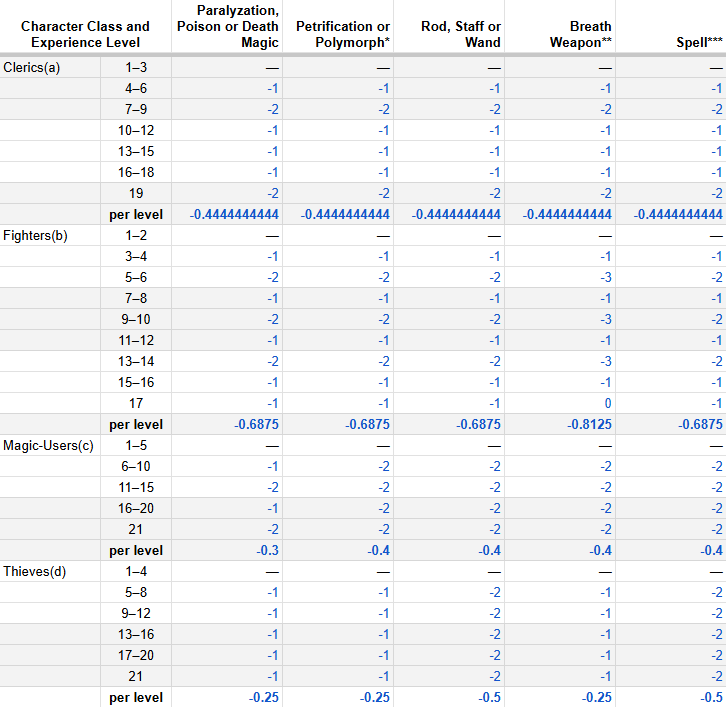
Wow, this seems pretty straightforward! All of the Cleric's saves actually have the same progression, even if the pattern's kinda weird. And all of the other classes have mostly consistent progressions, except that Fighters get a slightly better one for Breath, MUs get a worse one for Death (curious!), and Thieves get much better ones for Wands and Spells (which is further evidence for Wand effects just being considered weaker versions of Spell effects in this paradigm).
Notably, there are no crazy accelerations like the White Box MU's headlong charge towards spell immunity.
I don't know why the Fighter's last step doesn't make their Breath Weapon save any better; maybe taking full breath weapon damage only on rolls of 1 was just too good? I guess this explains why the Fighter starts off so bad against Breath, anyway. While the Fighter's saves start out the worst, that every-two-levels improvement rate actually gives them the best saves at high levels.
Looking at the per-level averages, we see the Cleric and MU's progress rates have gotten worse since the White Box days, while the Fighter's have kinda stayed the same. The Thief's rates are notably abysmal, except for Wands and Spells. Again, one could roughly convert these to simple fractional rates, but it'd take some uncomfortable rounding in a few places.
B/X
Okay, time for B/X D&D! I'm really curious about this one, due to that hack I've been contemplating.
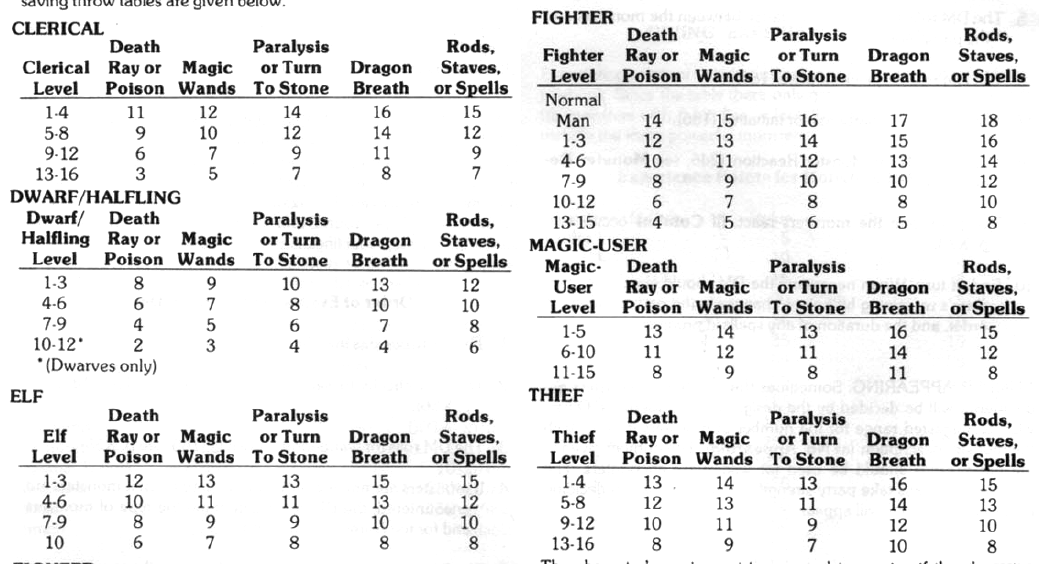
Huh. "Clerical". I dunno, that just seems like a weird place to use the adjective form. Sorry, the adjectival form.
Anyway, as expected, the B/X tables seem to ignore AD&D and iterate off White Box D&D directly. So, instead of Paralysis being folded into Death saves, it's added to Stone. Also, Rods and Staves are in there with Spells instead of Wands.
Also worth noting: Wow, the Dwarf and Halfling have great saves! I sorta remember that being their thing, but I'm really seeing it now. The Elf is really great, too, which is a little more surprising: That class already has so much going for it.
I'm still watching for that moment when the Wands save becomes about dodging wand beams rather than shrugging off their effects. I know that's definitely in place when the BECMI Master Rules come out (1985), because that's where we get optional rules to apply Dexterity modifiers to both Wands and Breath saves.
I'll skip the save difficulty check and the starting point comparison. Just as in OD&D, the difficulty hierarchy goes Death < Wands < Stone < Spells < Breath. Another way to put it would be that the hierarchy matches the column order if you're only considering the Fighter. If you factor in all classes, then Breath is tougher than spells.
So, let's get to the progressions!
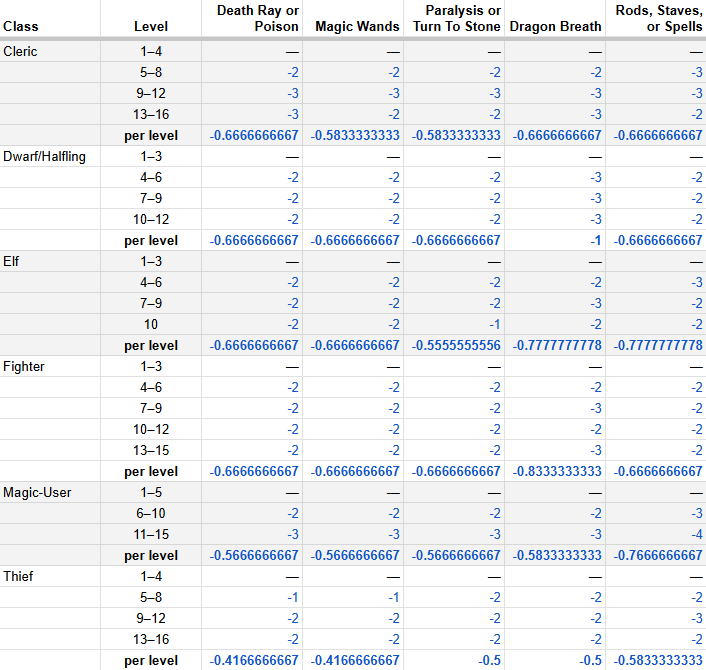
Looks like the Cleric, Fighter, and Magic-User have the same progression rates as in White Box D&D, so it's really just the demihumans and Thief who are new here. Looks like the demihumans, while they do have their own starting points, basically use the Fighter's progression rates. There are a couple differences, though: The Dwarf and Halfling actually get faster improvement in their Breath saves than the Fighter (I suspect some connection to The Hobbit). The Elf gets a little bit of a bonus against spells, and then their progress vs. Stone slows down at their maximum level. That seems especially weird given the Elf's famous resistance to paralysis effects.
The per-level rates are also very OD&D, and again I can imagine rounding each of these off to 1/2, 2/3, and 3/4 progressions.
AD&D 2e
Okay, so when I looked into oldschool attack mechanics, 2e was like a breath of fresh air, making everything a hell of a lot simpler. Let's see if that happens again for saving throws.
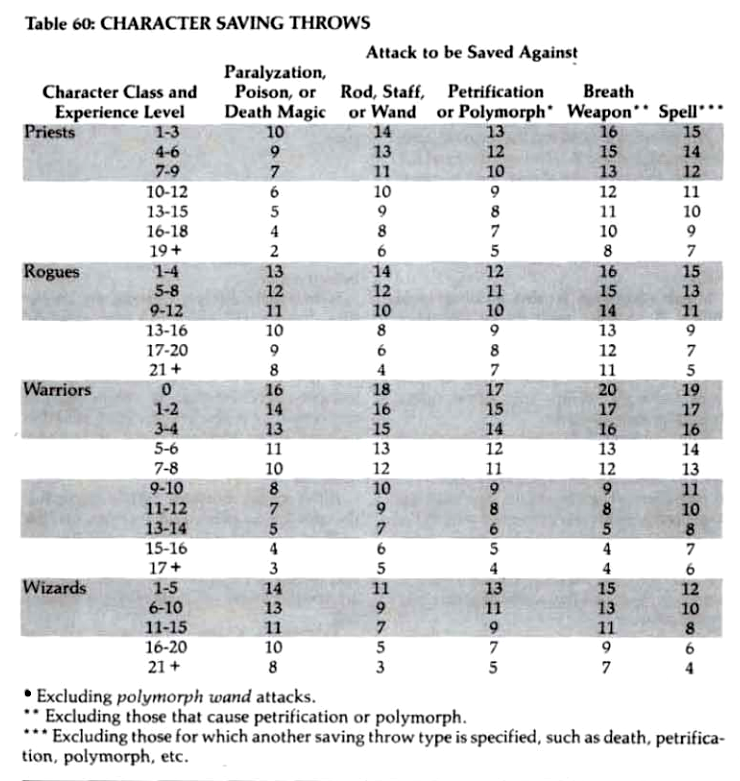
Wow. It's . . . the same. With the exception of the Wands and Petrification columns being swapped to match the non-Advanced line, and the class names being swapped for class groups, this is exactly the same as the 1e table!
I guess I can skip the analysis for this edition, but I'm left wondering why there weren't any changes here. Why didn't the saving throw tables get the same kind of simplification as the attack roll tables? Maybe they figured saves weren't broken and didn't need fixing, or maybe they just didn't want to get into the math.
Rules Cyclopedia
Okay, here we go. Last time, the Rules Cyclopedia was where things really got crazy, and I think saving throws were pretty goofy from the start. Or will the RC table just be an extended version of the B/X one? Let's see!
...Oh, no! Turns out this is the edition where they finally put the saving throws in the individual class sections instead of combining them in a totally separate part of the book! It's surely better for actual play, but it's definitely more annoying for me.
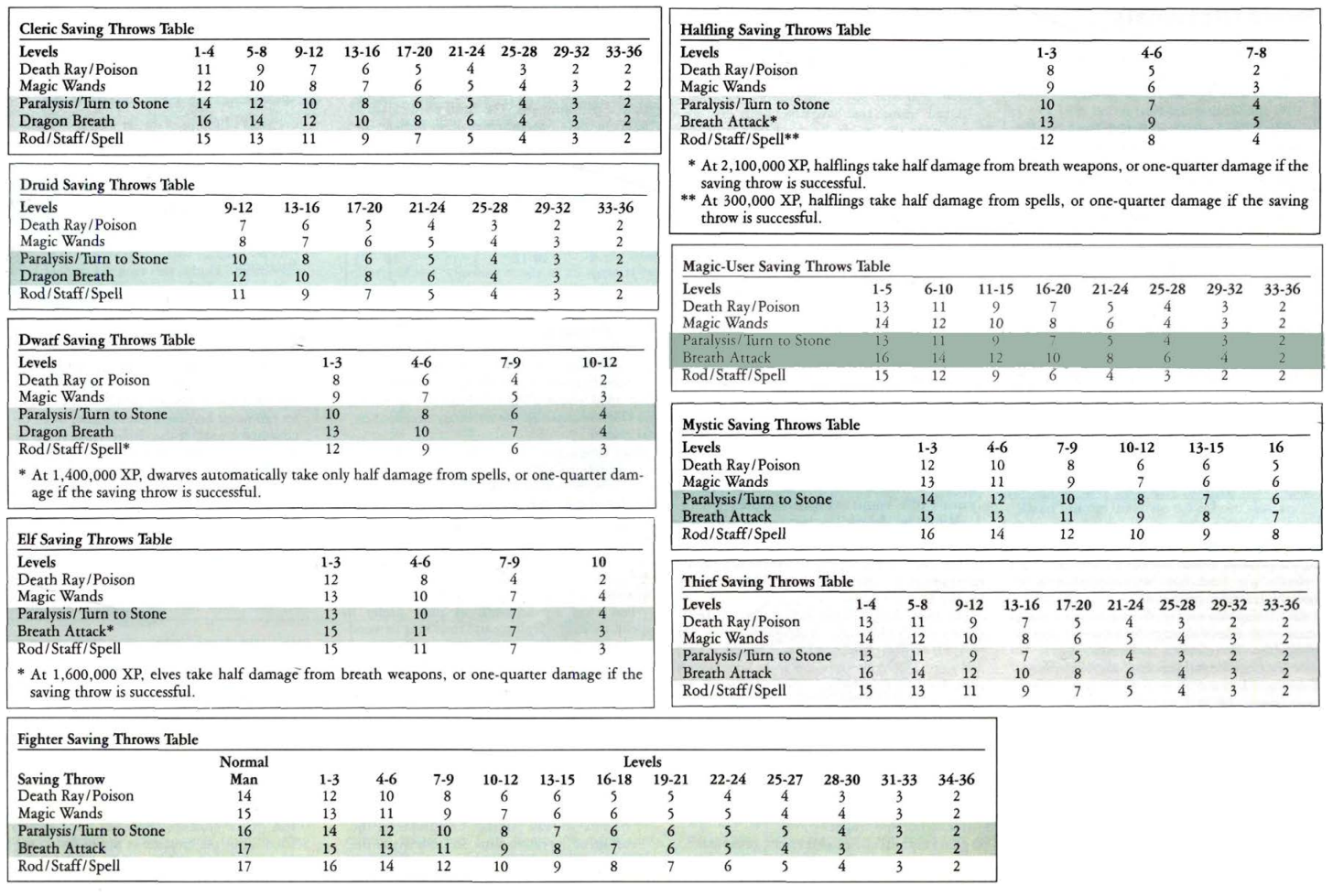
I've gotta go back to the bullet points for this one.
- Whoops! Three of these tables say "Dragon Breath" and six say "Breath Attack".
- Amazing that the non-Advanced line has resisted using the word "petrification" all the way to 1991.
- While AD&D 2e didn't really change the 1e saving throw tables, RC's saving throws are significantly different from B/X's, even if you only look at the low levels.
- Man, nothing highlights those demihuman level limits like seeing them alongside those giant, 36-level BECMI/RC progressions.
- That said, those asterisk notes are about some crazy post-level-limit stuff that demihuman PCs can get, similar to those letter-graded "attack ranks" from last post.
- I was surprised to see Druids and Mystics! In this edition, the Druid is basically a Cleric prestige class—which is why it starts at level 9—while the Mystic is a martial artist like the WotC-era Monk, not a psionicist like the 5e Mystic. I don't know why the Mystic tops out at level 16.
- Unsurprisingly, the usual saving throw difficulty hierarchy remains.
It's also worth pointing out that this edition has an optional rule for factoring a bunch of different abilities into saving throws.
Strength: Modifies saving throws vs. paralysis and turn to stone.
Intelligence*: Modifies saving throws vs. mind attacks (charm, confusion, control, fear, feeblemind, sleep, etc.).
Wisdom*: Modifies saving throws vs. spells.
Dexterity: Modifies saving throws vs. wands and dragon breath.
Constitution: Modifies saving throws vs. poison (but not vs. death ray).
Charisma: No bonus to saving throws.
* Combined modifier cannot exceed +/-3.
I like this option! I'm actually more excited to see saving throws influenced by ability scores than by class. There are a few odd things here, though. I don't know why Constitution shouldn't protect you from death rays, for one thing. This also makes it clear that, in this edition, the Wands and Breath saving throws are kind of doing the same thing. I guess the idea is that Wands is for beams and Breath is for area effects, which is why Breath is more difficult. Works for me.
Anyway. Let's see what the progressions look like.
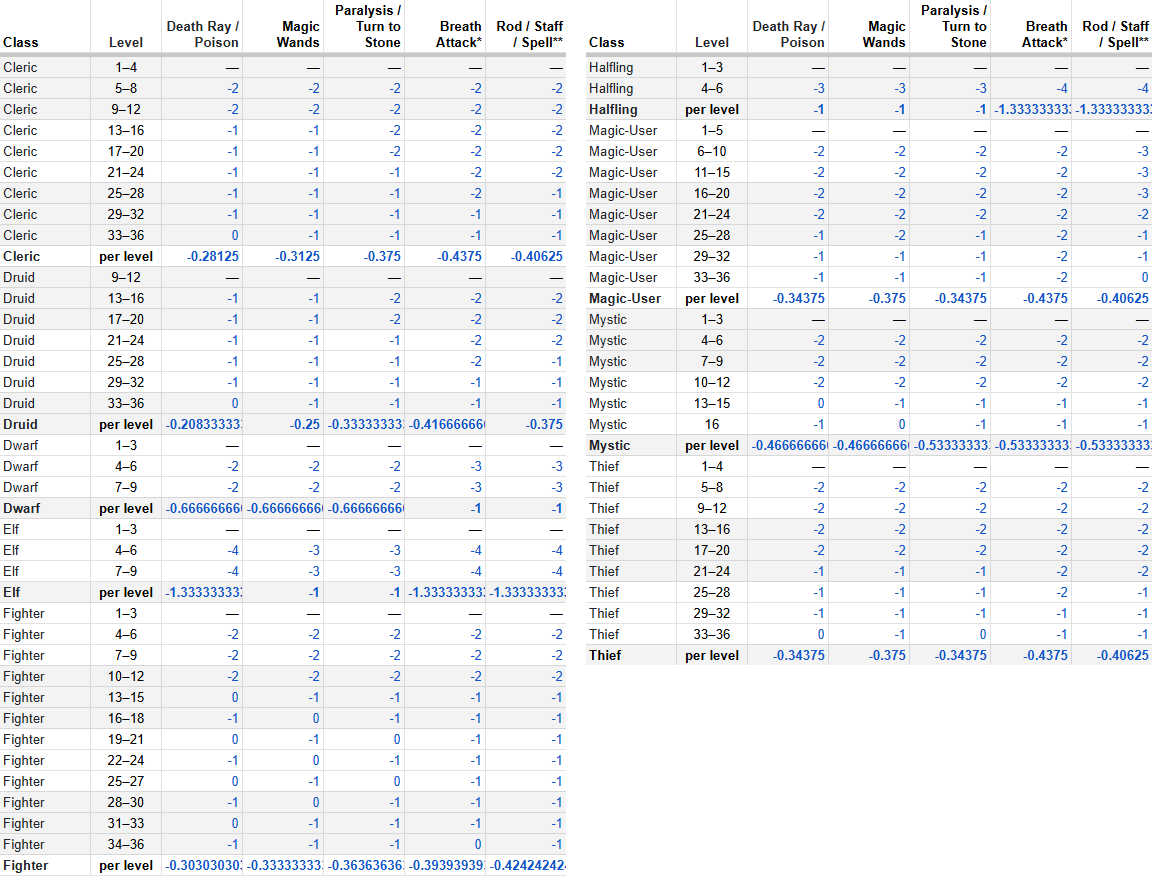
So that's a lot of data, but the thing that jumps out at me is the way progress slows down towards the highest levels of a lot of these classes. And it's easy to understand why: The target numbers should never drop below 2—since a roll of 1 should always be a failure—and most classes go up to level 36! Anyway, given the changing progress rates, it's no surprise that the per-level rates come out looking a bit haphazard.
The other thing I can't help but notice is that the Elf and Halfling both have crazy stupid good progress rates. I mean wow.
It looks a lot like high-level RC characters are all but untouchable, which I suppose fits into the whole transition-from-adventurer-to-immortal thing.
In conclusion
As I feared, it's hard to find a lot of straightforward logic in the old saving throw tables. Instead, it all feels . . . well, not exactly vibes-based, but kinda hand-crafted. It's not as elegant as I'd like, you know? Lotta compromises and in-flight course corrections.
Anyway, the B/X tables were my main interest through all of this, and they at least point the direction towards a simple solution: I honestly think I'd just use a 2/3 progression for every class in every save. The distinctions between each—to the extent that I want any—could be baked in from the starting numbers. If everyone improves at the same rate, those different starting points will always matter.
However, I'm still not fully sold on this whole paradigm for saving throws! The messiness of what you roll for a flesh to stone spell or a gorgon's breath is annoying. I've heard it explained that you resolve ambiguities by just going with the leftmost applicable column (which will usually mean the easier save), and that definitely helps practically . . . but not aesthetically. The arguments I've heard for threat-focused saves (Poison, Dragon Breath, Spell) as opposed to defense-focused saves (Fortitude, Reflex, Will) is that the former tells you from the start what kinds of troubles you'll face in the game, and lets you decide narratively how your character avoids them. But I dunno; those ideas just don't do much for me.
However, I have heard some compelling arguments for making the difficulty of saving throws completely based on the character rolling the save, rather than on the potency of the threat: It avoids situations where, due to relative power levels, success is impossible or inevitable. So that's cool, at least. And relevant to that dumb hack idea I can't stop contemplating.
